
THE DISSERTATION STATS HELPER BLOG
Evidence for your
dissertation decisions.
Data-driven looks at how doctoral research is actually done, and practical guidance for planning, analyzing, and defending your own study.
SERIES · METHODS IN PSYCHOLOGY DISSERTATIONS AND THESES
What psychology dissertations
and theses actually use.
What 21,308 recent dissertation and thesis abstracts say about the statistics psychology students actually use, overall and subfield by subfield.
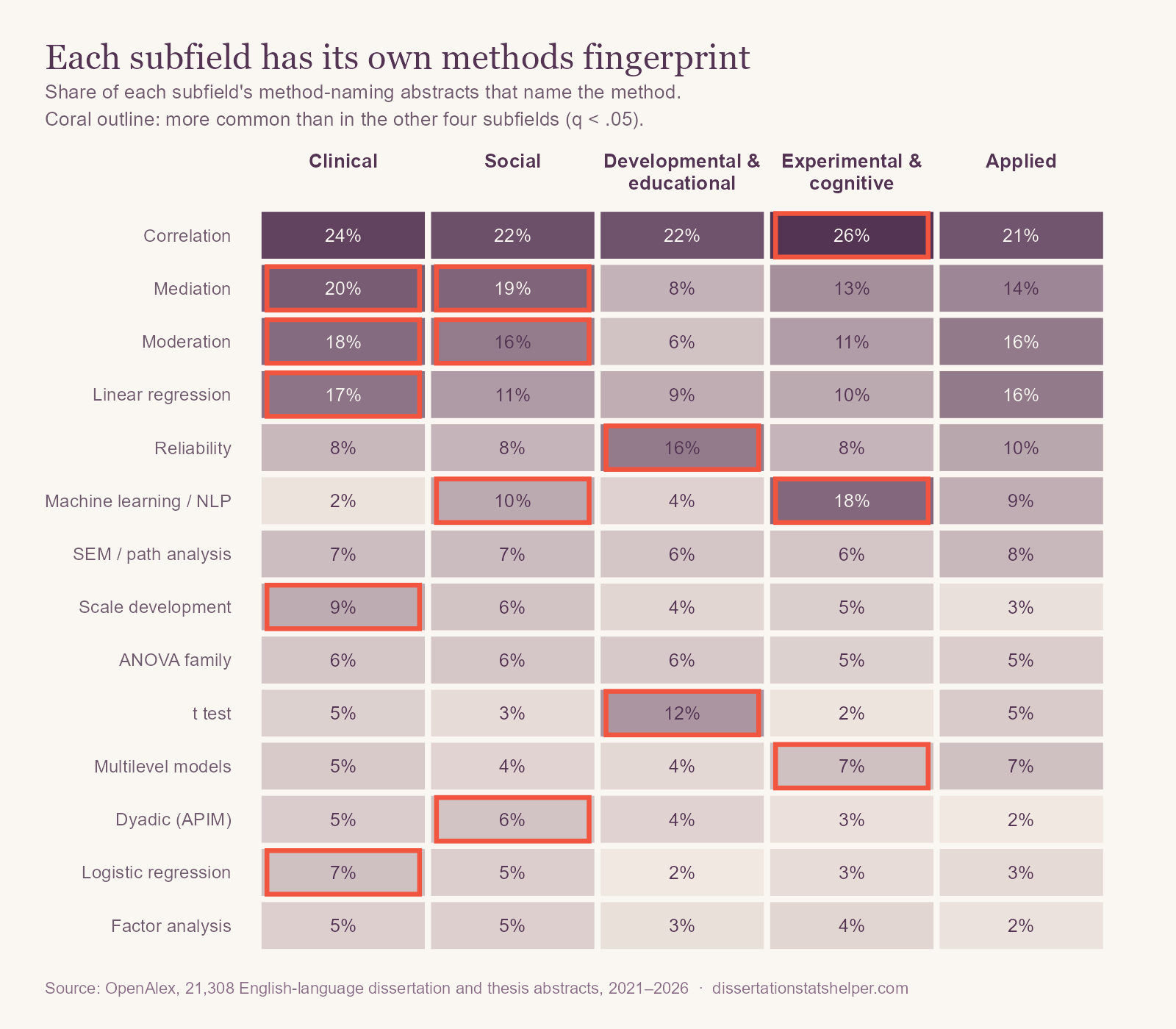
We analyzed 21,308 psychology dissertation and thesis abstracts published since 2021. Correlation, mediation, and moderation lead; each subfield has its own methods fingerprint; and the analyses committees ask about most barely appear.
Read the overview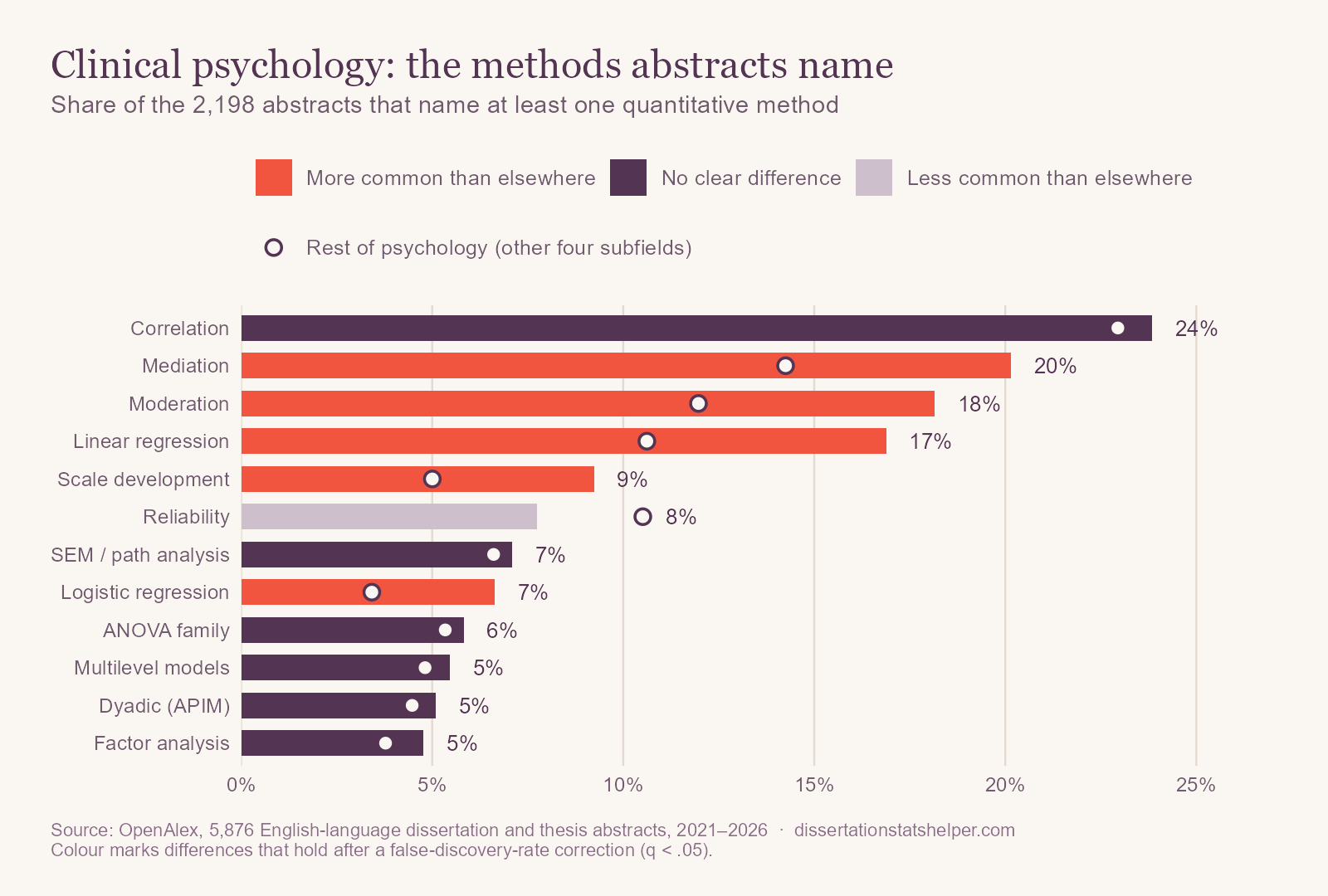 CLINICAL PSYCHOLOGYWhat statistics do clinical psychology dissertations and theses use?
Across 5,876 clinical psychology dissertation and thesis abstracts since 2021, mediation, moderation, and regression appear more often than anywhere else in psychology. Here is the full picture, and what it means for your own study.
Read the breakdown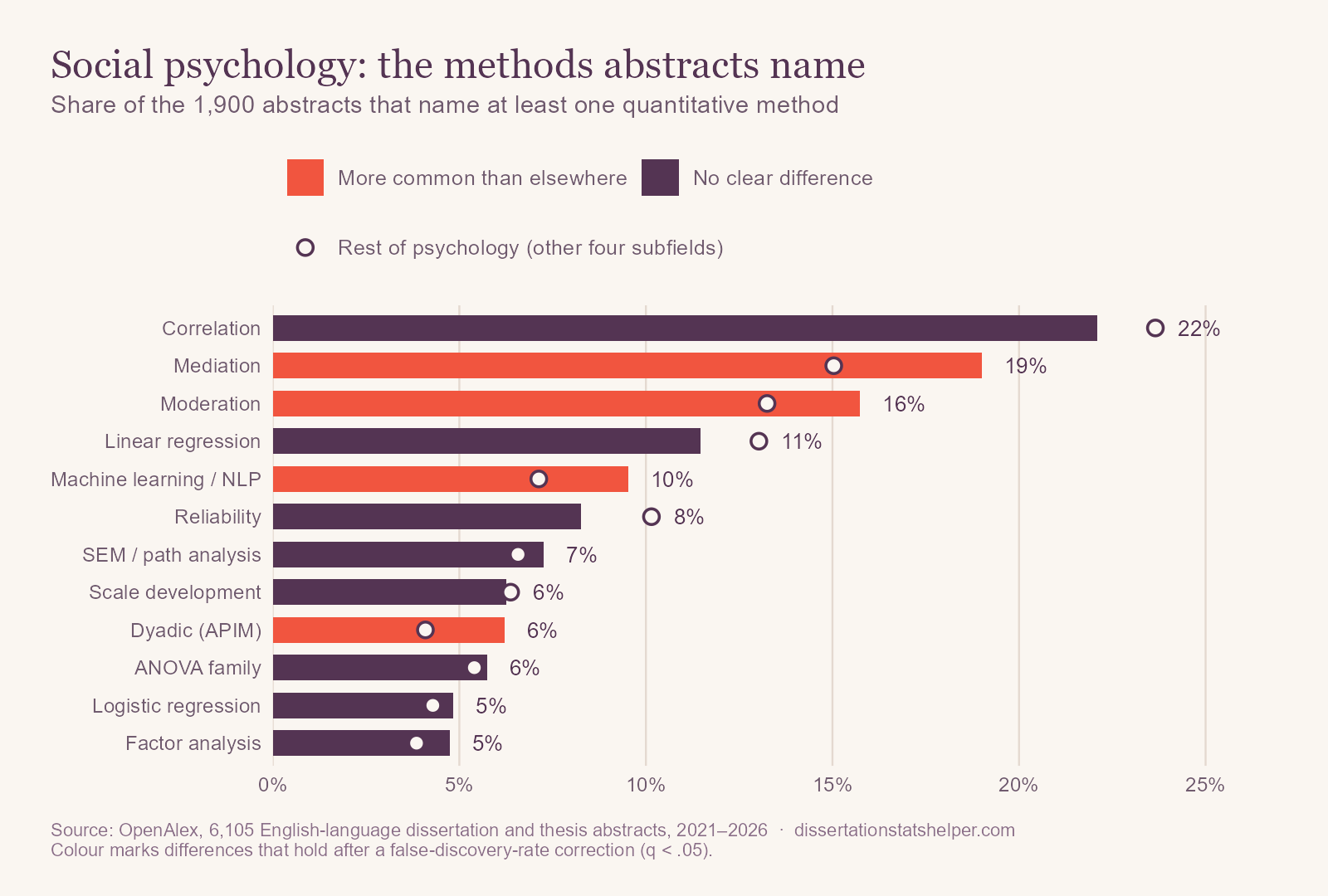 SOCIAL PSYCHOLOGYWhat statistics do social psychology dissertations and theses use?
In 6,105 social psychology dissertation and thesis abstracts since 2021, mediation and moderation are unusually common, dyadic models stand out, and reliability reporting has doubled.
Read the breakdown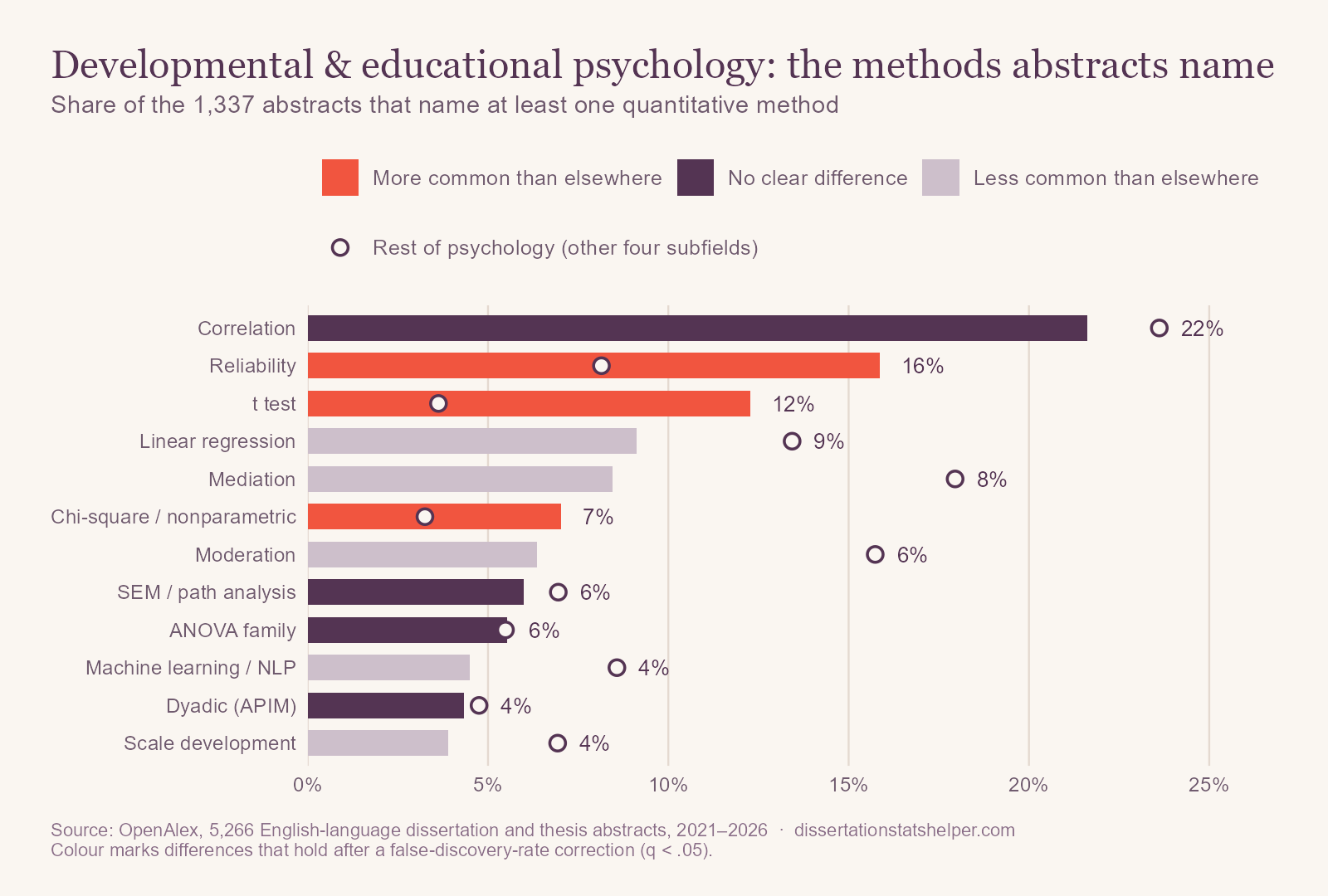 DEVELOPMENTAL & EDUCATIONAL PSYCHOLOGYWhat statistics do developmental and educational psychology dissertations and theses use?
Developmental and educational psychology dissertations name t tests three times as often as the rest of psychology and reliability twice as often, while multilevel models remain rare. A look at 5,266 abstracts since 2021.
Read the breakdown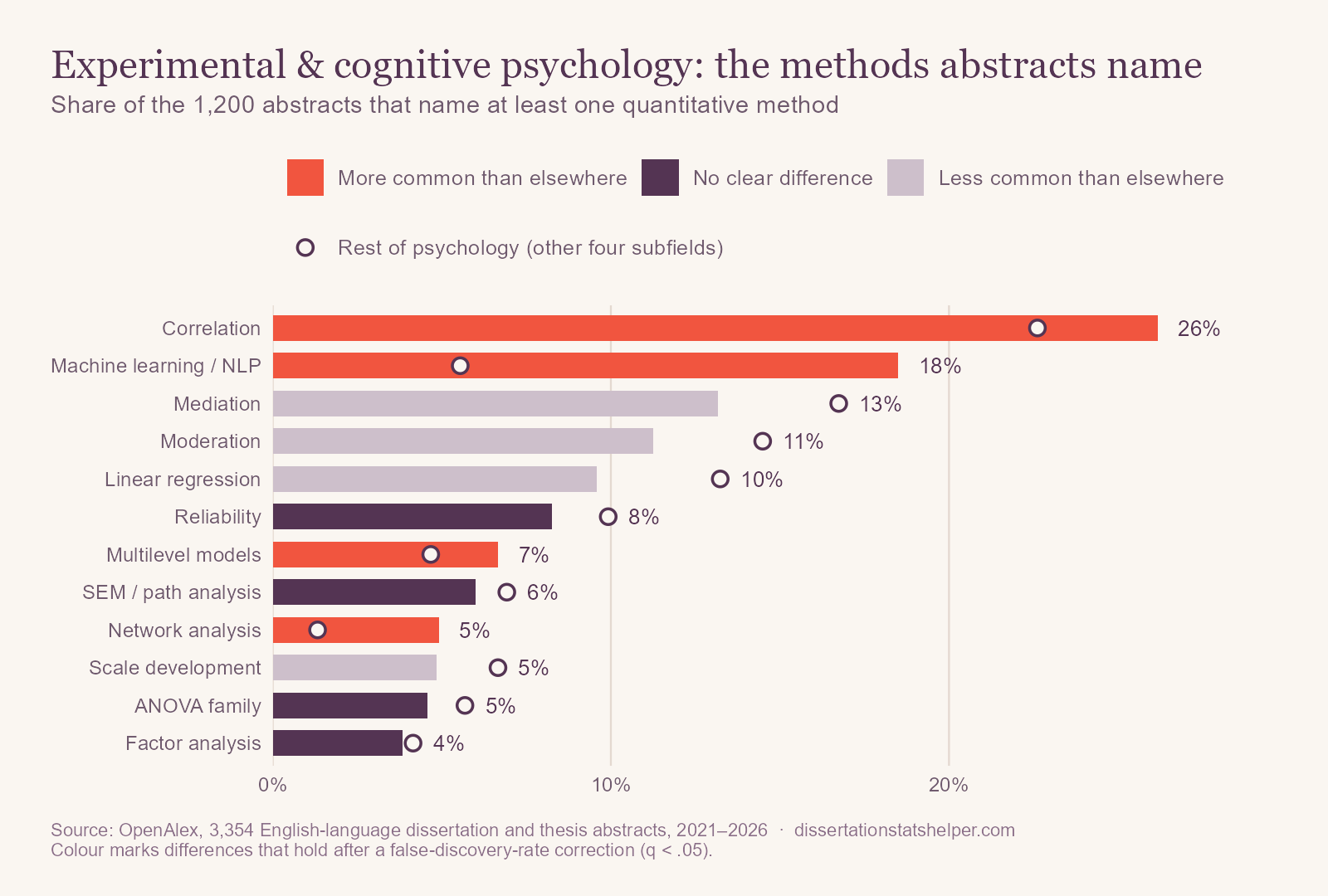 EXPERIMENTAL & COGNITIVE PSYCHOLOGYWhat statistics do experimental and cognitive psychology dissertations and theses use?
Experimental and cognitive psychology dissertations name machine learning more than three times as often as the rest of psychology, along with network analysis and Bayesian methods. A look at 3,354 abstracts since 2021.
Read the breakdown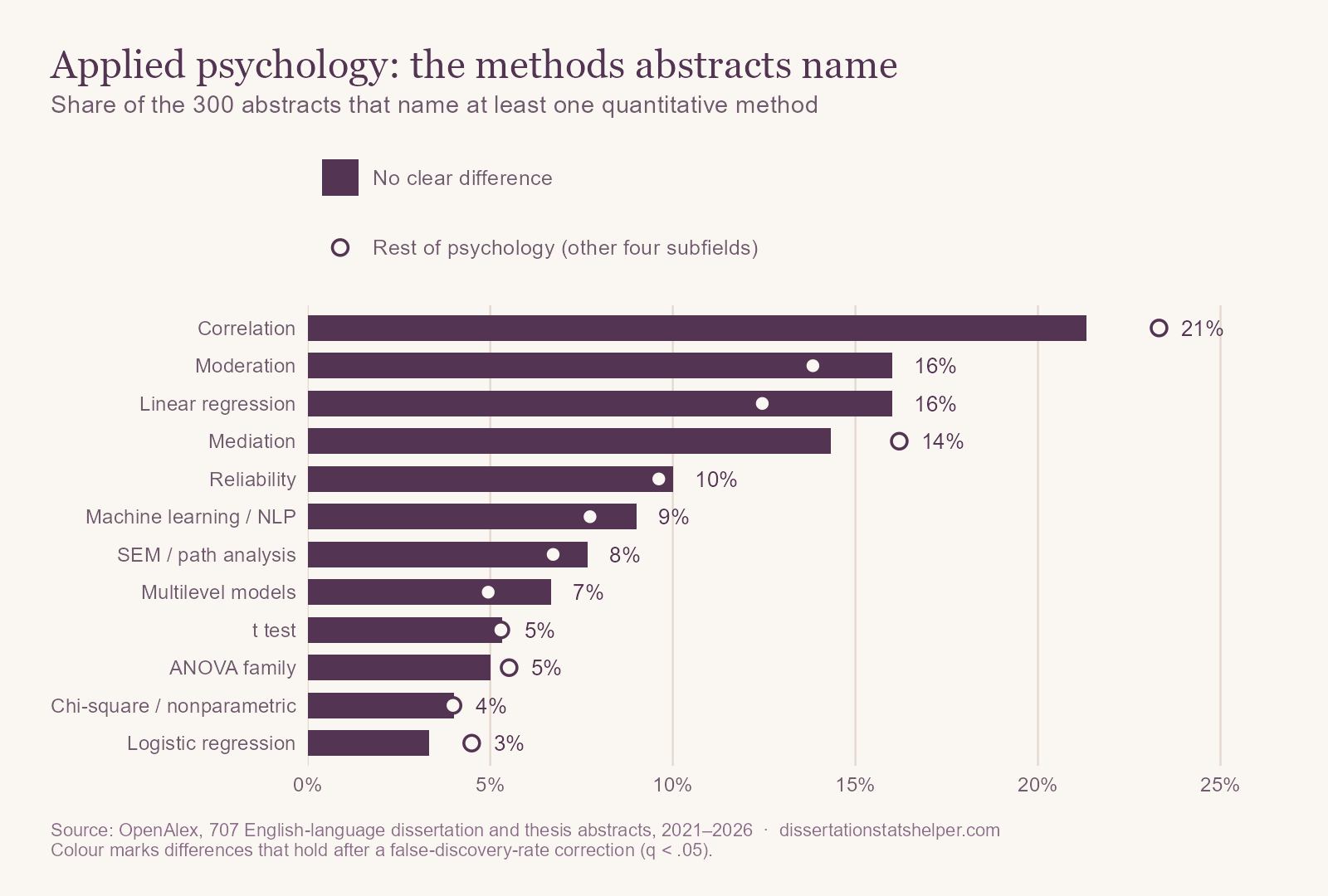 APPLIED PSYCHOLOGYWhat statistics do applied psychology dissertations and theses use?
Applied psychology is the smallest subfield in our data, and the most intervention-focused: 707 abstracts since 2021, with the highest share of experiments and quantitative methods in psychology.
Read the breakdownSERIES · METHODS IN EDUCATION DISSERTATIONS AND THESES
What education dissertations
and theses actually use.
What 18,617 recent education dissertation and thesis abstracts say about the statistics students use, overall and area by area, and how US work differs.
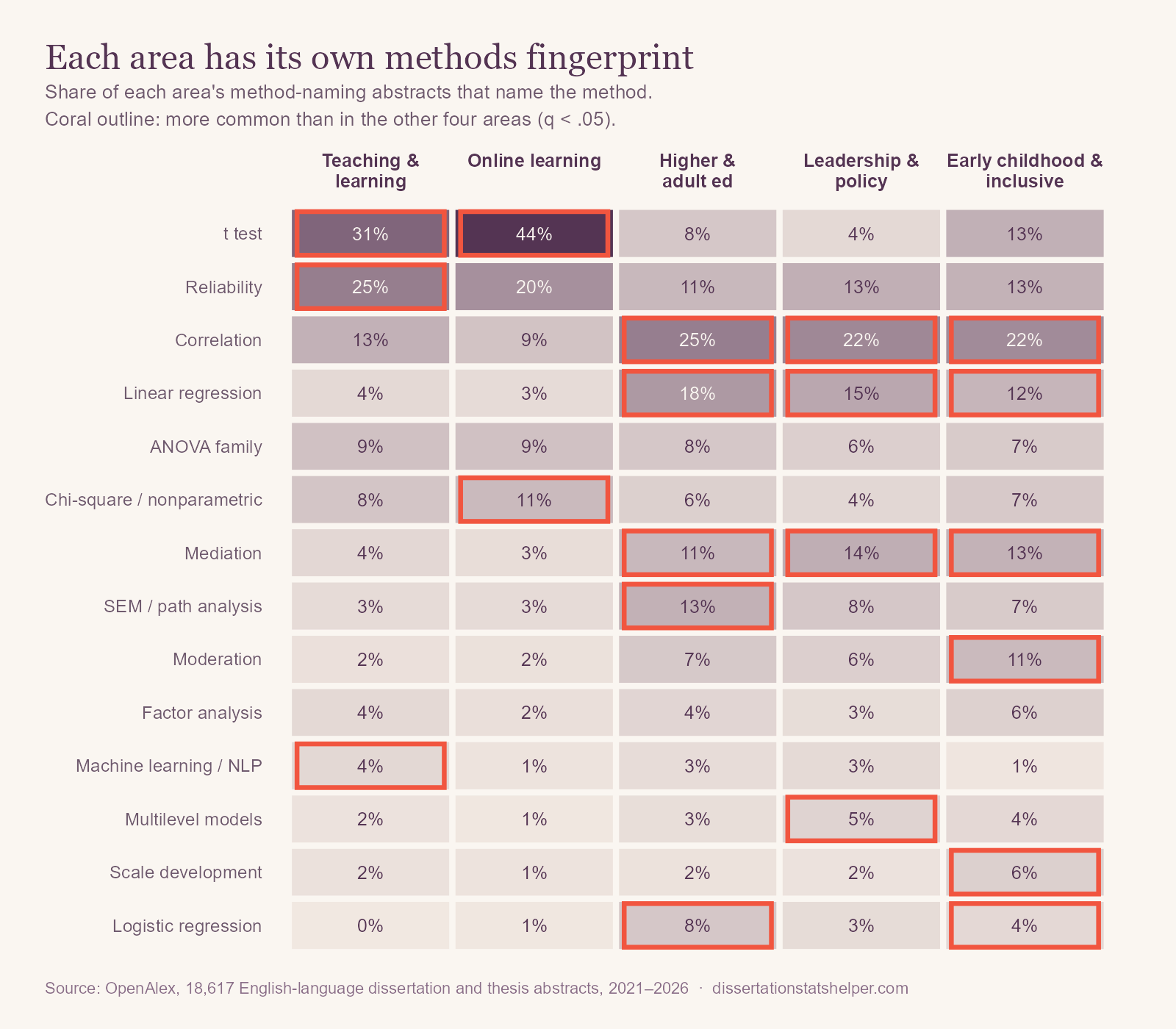
We analyzed 18,617 education dissertation and thesis abstracts published since 2021. Most never name a statistical method, the ones that do split into two very different toolkits, and US-based work looks unlike the global picture.
Read the overview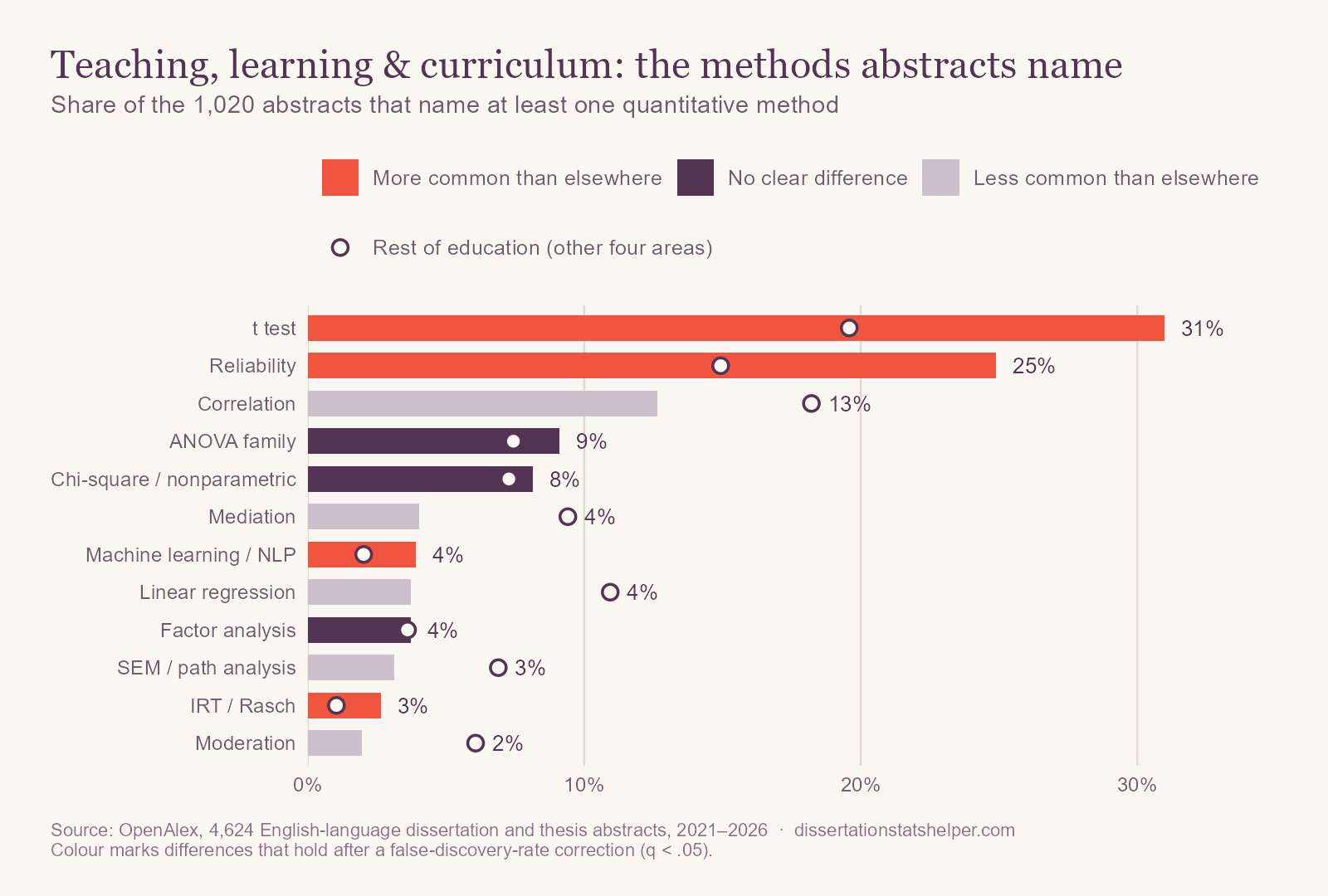 TEACHING, LEARNING & CURRICULUMWhat statistics do teaching and learning dissertations and theses use?
Across 4,624 abstracts on teaching, learning, and curriculum since 2021, the pretest–posttest toolkit dominates: t tests, reliability, and ANOVA, with little regression or modeling.
Read the breakdown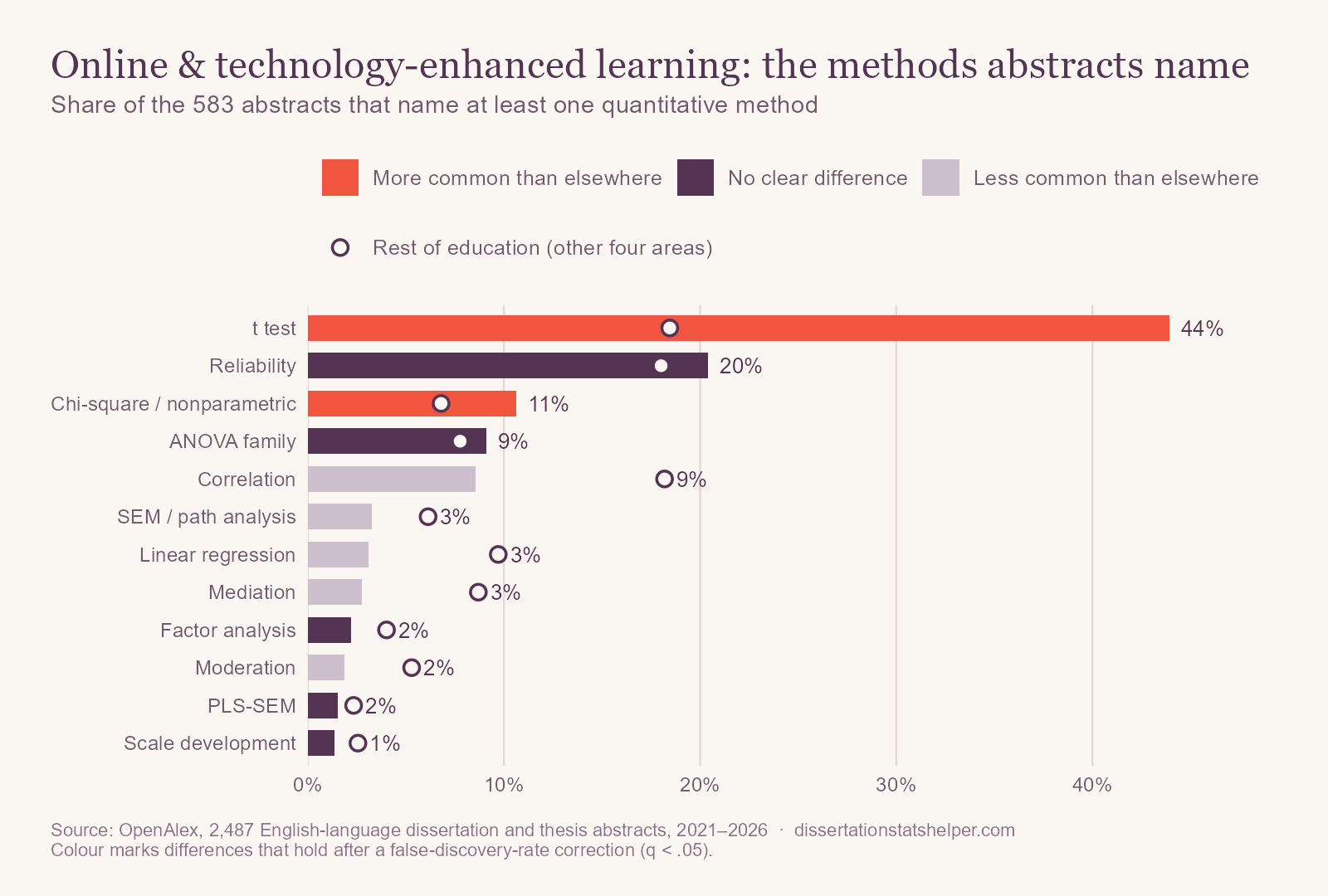 ONLINE & TECHNOLOGY-ENHANCED LEARNINGWhat statistics do online learning dissertations and theses use?
Online and technology-enhanced learning dissertations name t tests in 44% of method-naming abstracts, the highest share of any area we have analyzed. A look at 2,487 abstracts since 2021.
Read the breakdown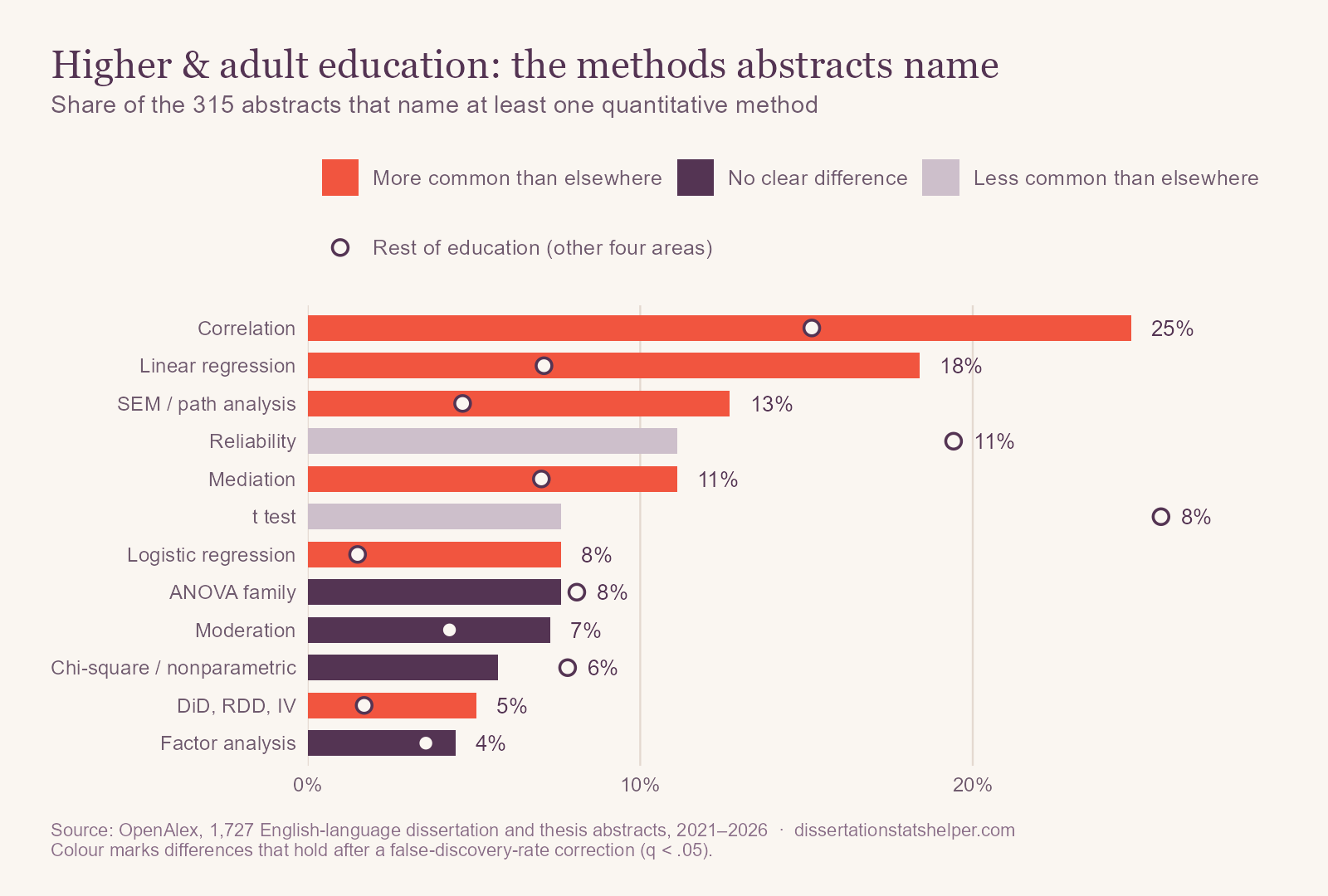 HIGHER & ADULT EDUCATIONWhat statistics do higher education dissertations and theses use?
Higher and adult education dissertations are the most qualitative in education, and their quantitative work leans on regression, structural equation models, and student outcomes like retention. A look at 1,727 abstracts since 2021.
Read the breakdown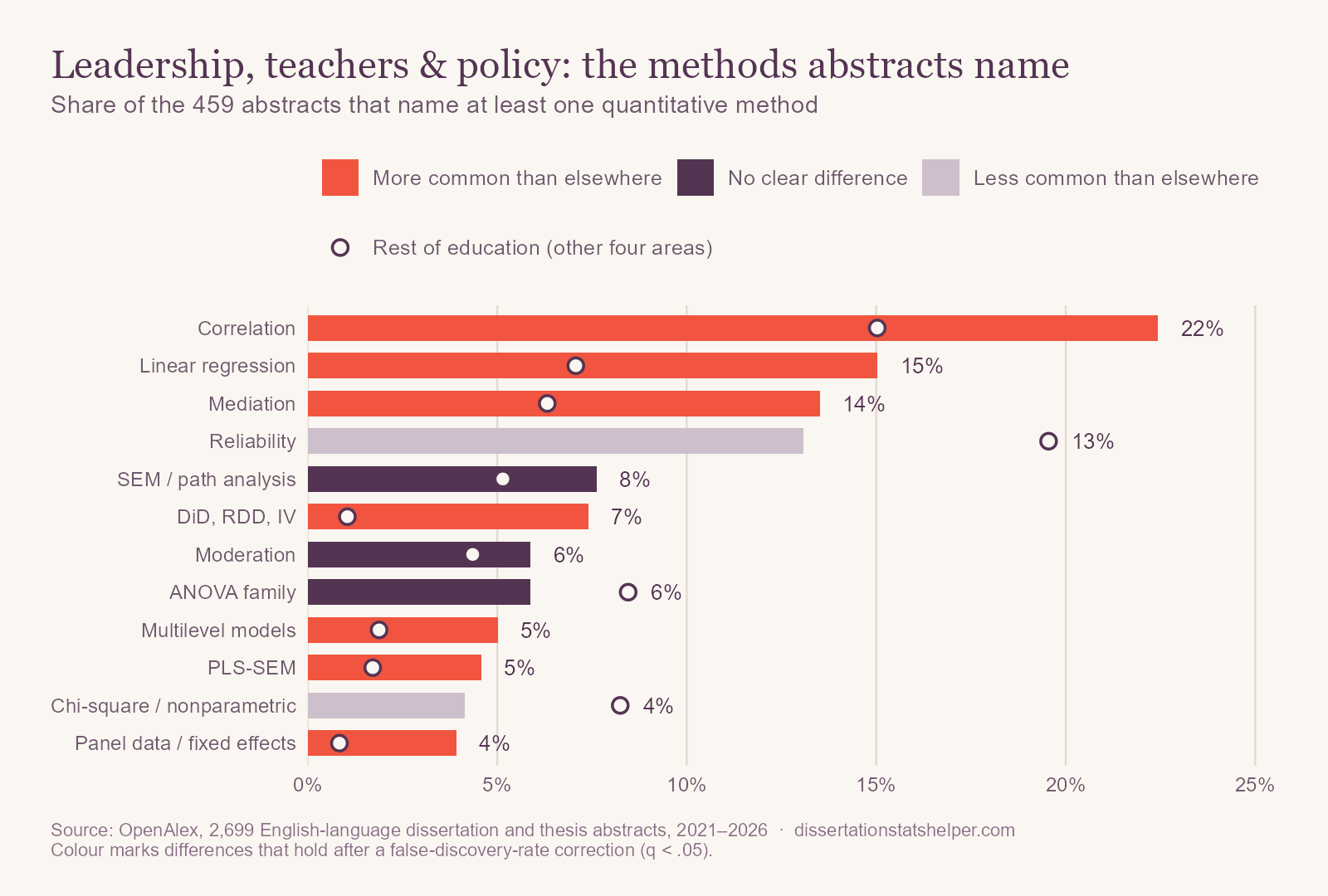 LEADERSHIP, TEACHERS & POLICYWhat statistics do educational leadership and policy dissertations and theses use?
Educational leadership, teacher, and policy dissertations use regression, mediation, and causal designs far more than the rest of education, and structural equation models are rising. A look at 2,699 abstracts since 2021.
Read the breakdown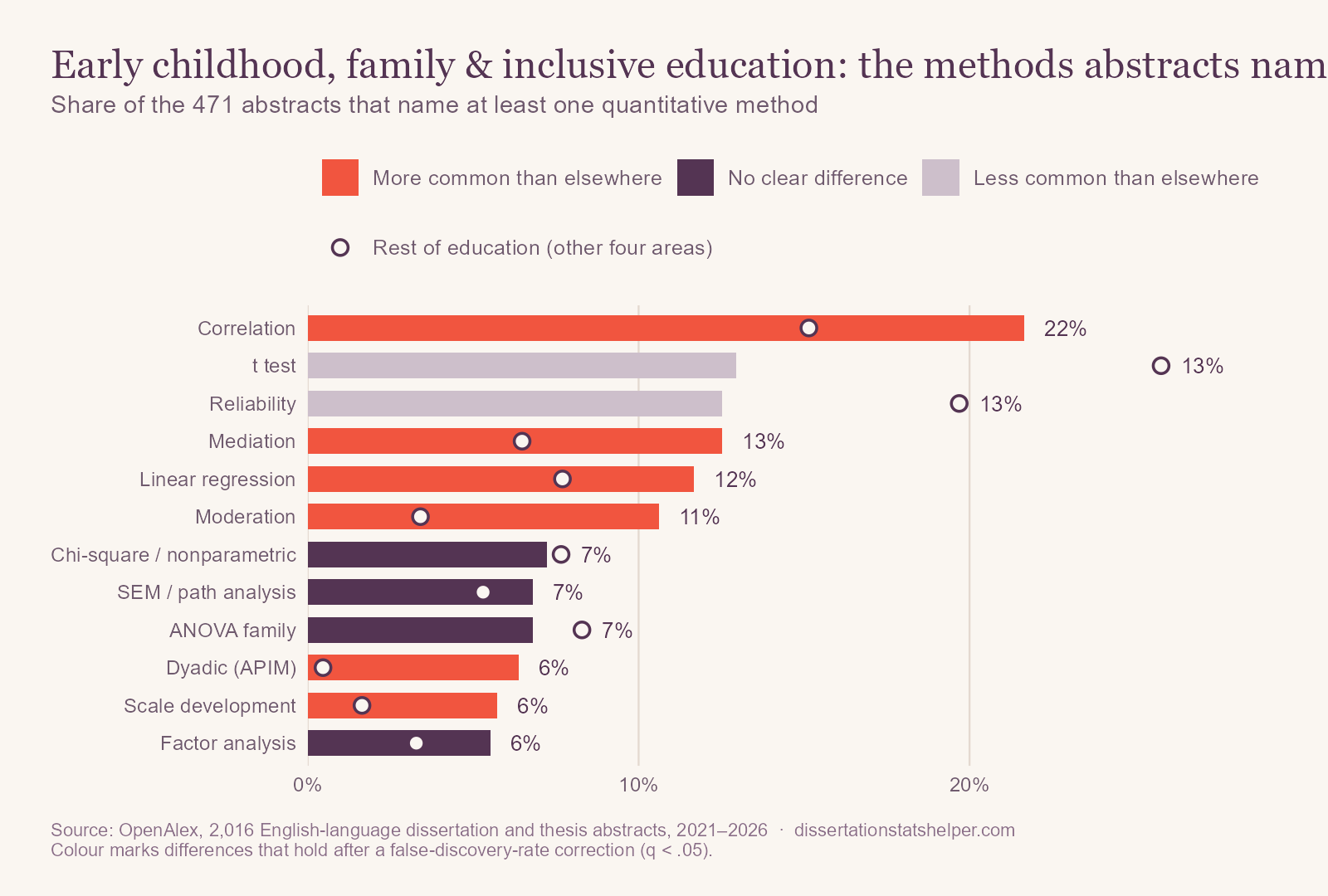 EARLY CHILDHOOD, FAMILY & INCLUSIVE EDUCATIONWhat statistics do early childhood and inclusive education dissertations and theses use?
Early childhood, family, and inclusive education dissertations borrow from developmental psychology: mediation, moderation, parent–child dyads, and latent profiles. A look at 2,016 abstracts since 2021.
Read the breakdownSERIES · METHODS IN BUSINESS DISSERTATIONS AND THESES
What business dissertations
and theses actually use.
What 22,179 recent business dissertation and thesis abstracts say about the statistics students use: survey models in some areas, econometrics in others.
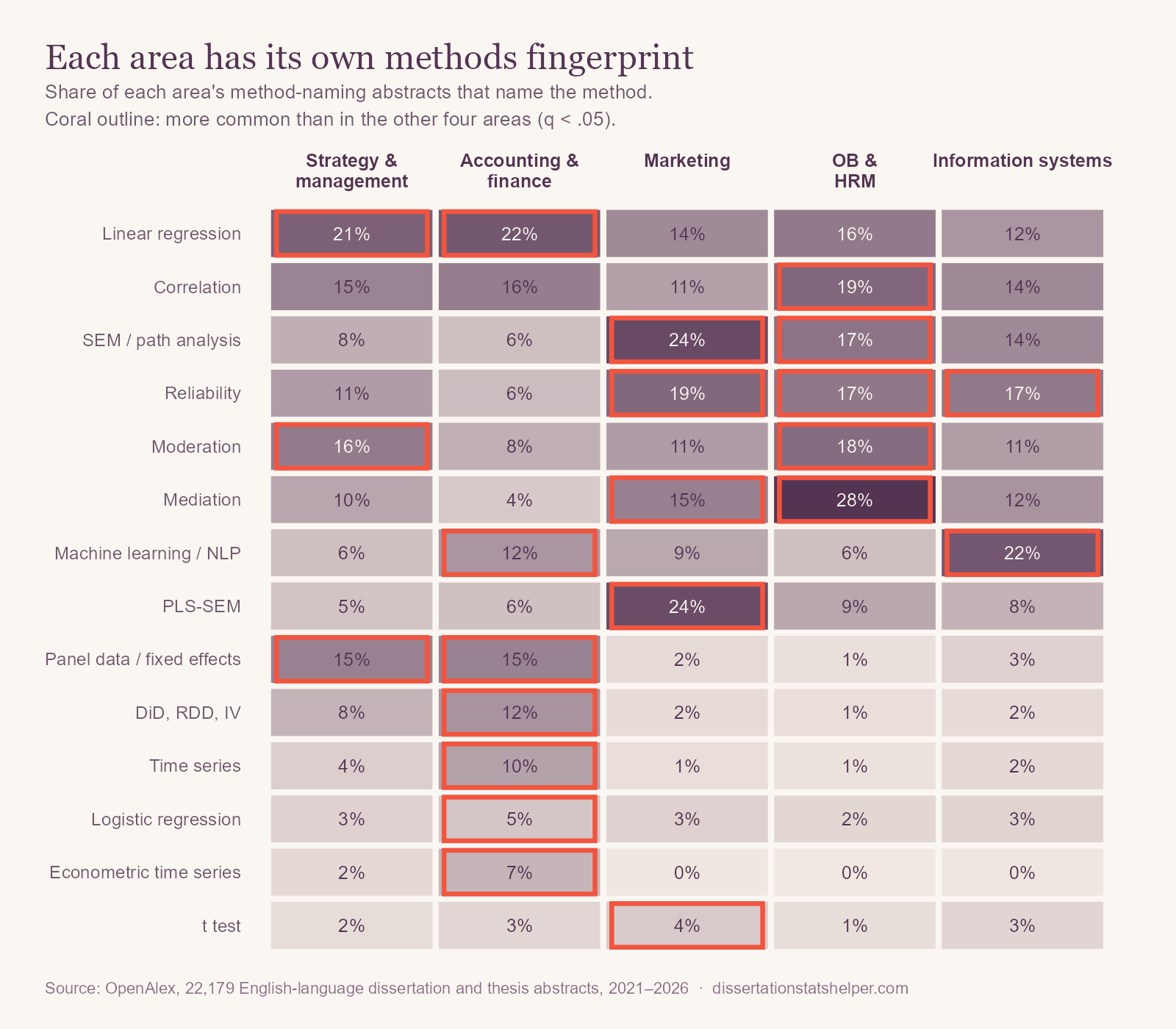
We analyzed 22,179 business dissertation and thesis abstracts published since 2021. Business splits into two toolkits, survey models and econometrics, and both are growing.
Read the overview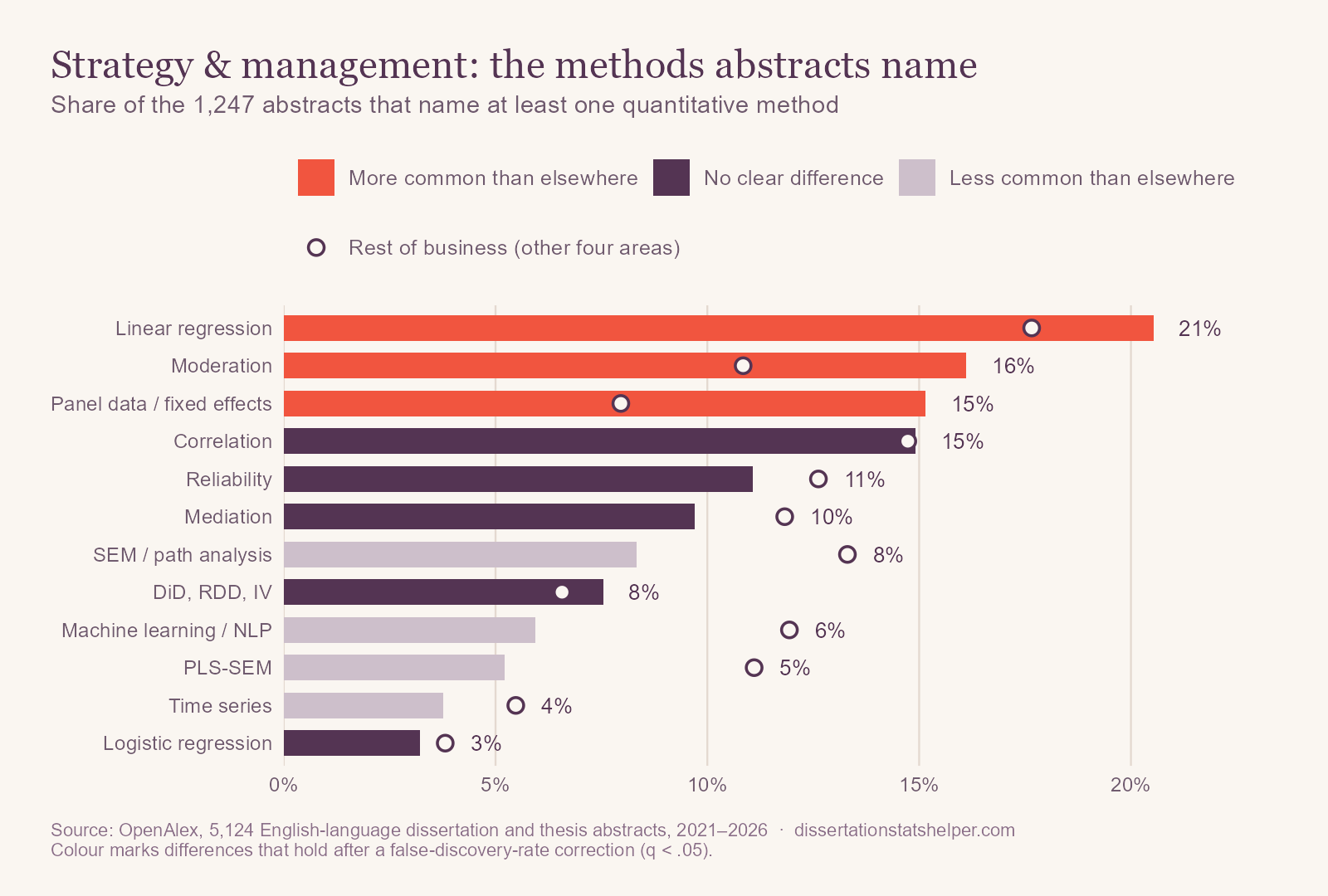 STRATEGY & MANAGEMENTWhat statistics do strategy and management dissertations and theses use?
Strategy and management dissertations combine firm-level panel data with moderation-heavy theory testing. A look at 5,124 abstracts since 2021.
Read the breakdown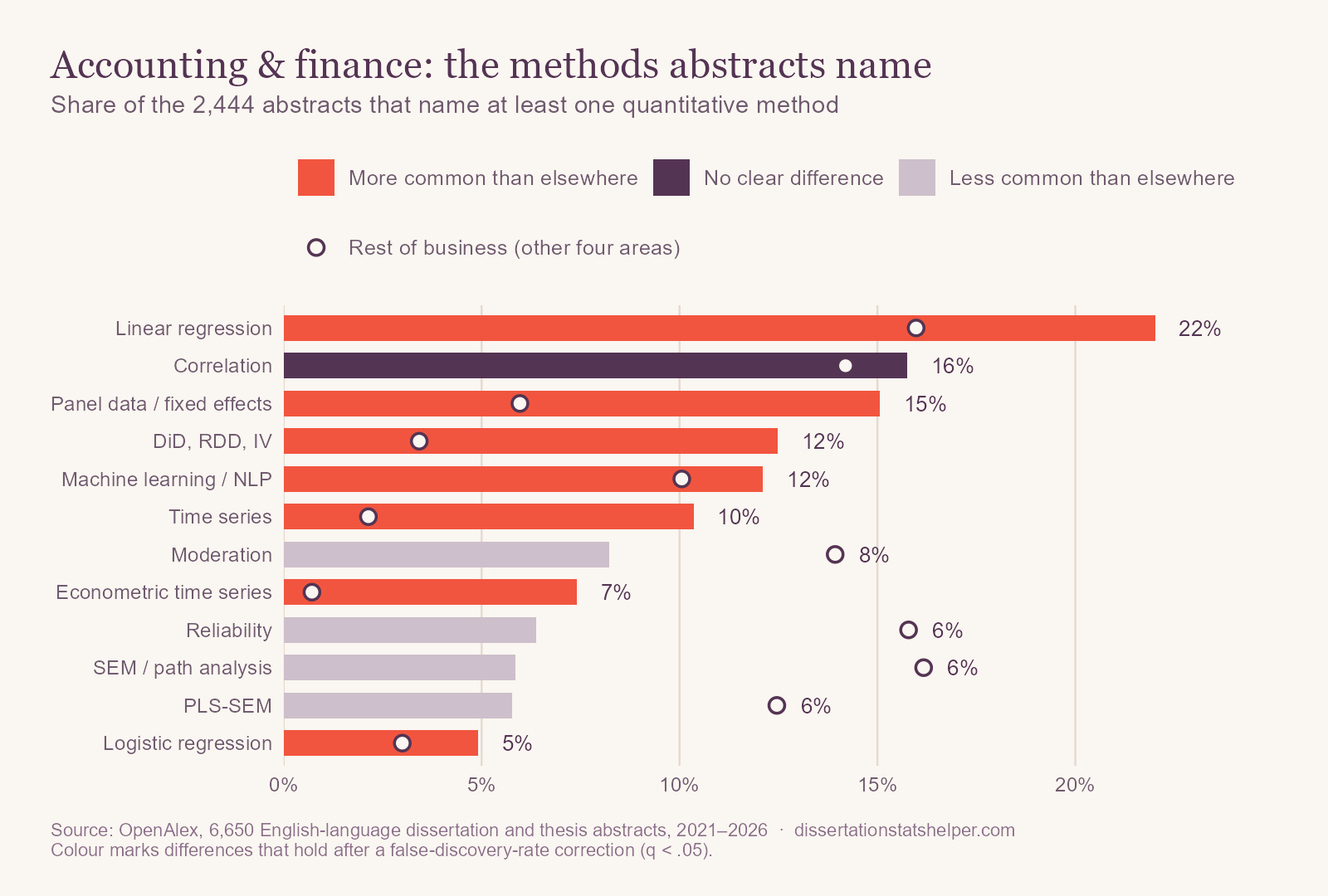 ACCOUNTING & FINANCEWhat statistics do accounting and finance dissertations and theses use?
Accounting and finance dissertations are the most quantitative in business, built on regression, panel models, causal designs, and time series. A look at 6,650 abstracts since 2021.
Read the breakdown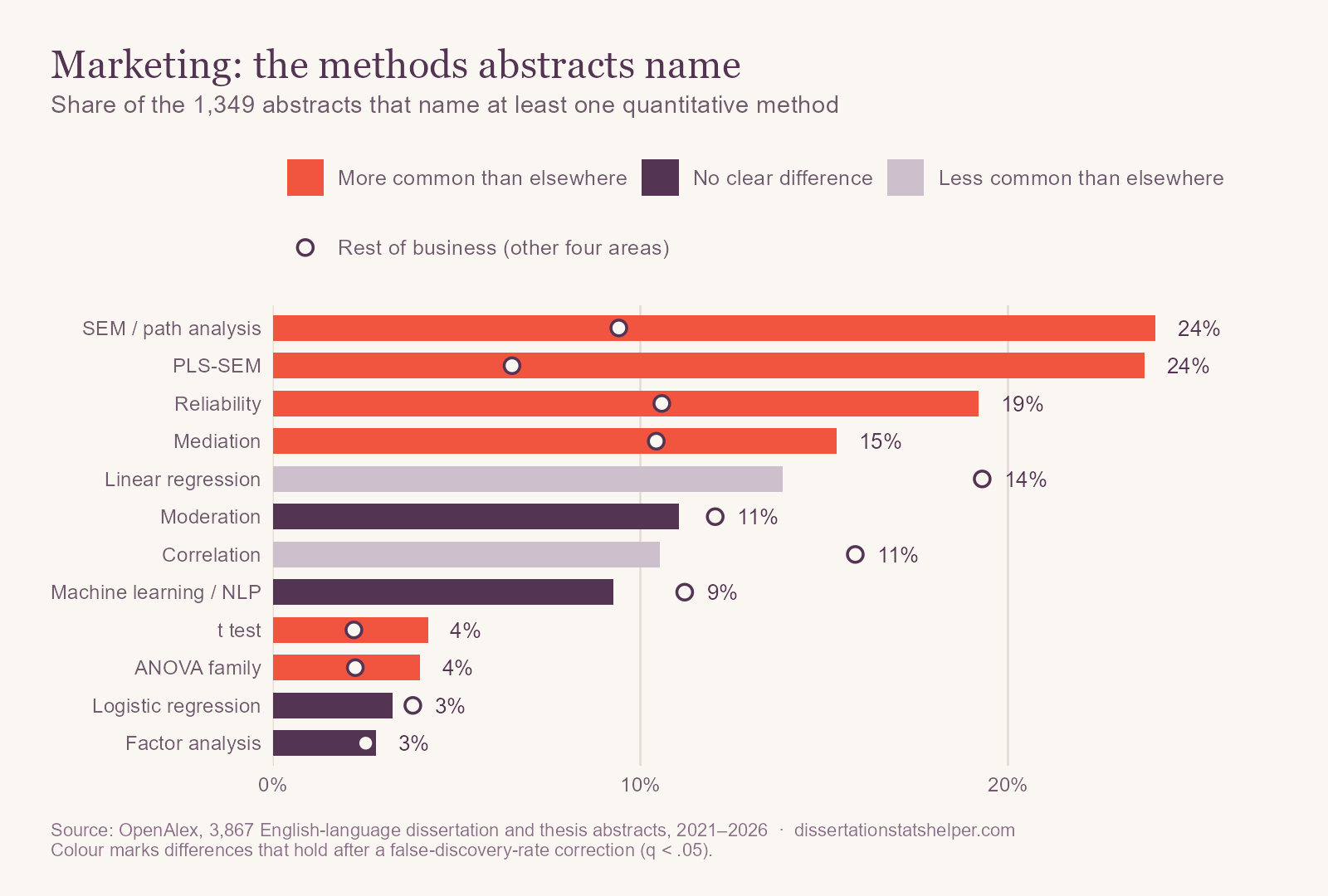 MARKETINGWhat statistics do marketing dissertations and theses use?
Marketing dissertations name structural equation models more than any other method: SEM and PLS-SEM each appear in 24% of method-naming abstracts. A look at 3,867 abstracts since 2021.
Read the breakdown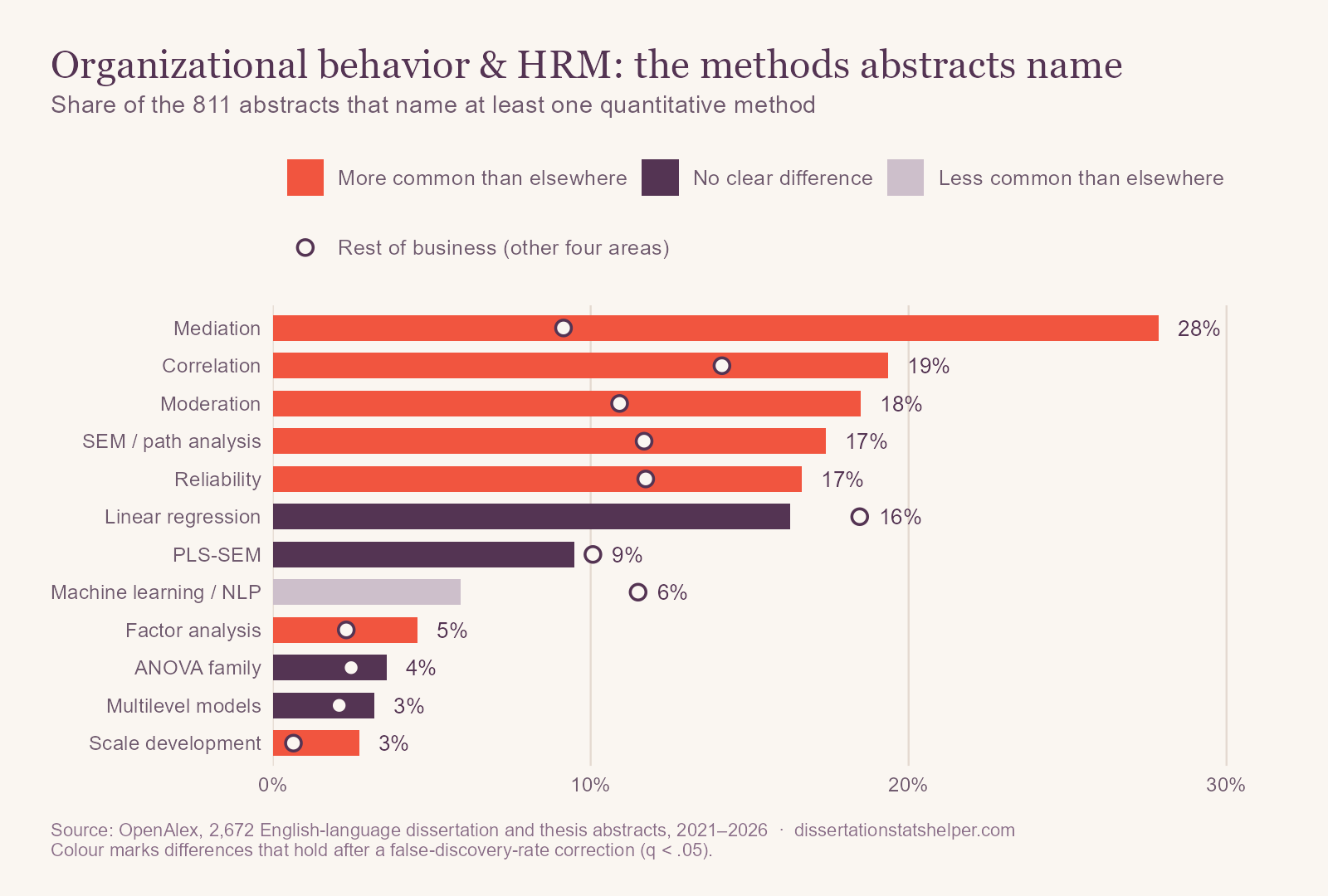 ORGANIZATIONAL BEHAVIOR & HRMWhat statistics do organizational behavior and HRM dissertations and theses use?
Organizational behavior and HRM dissertations name mediation in 28% of method-naming abstracts, more than any other area we have analyzed. A look at 2,672 abstracts since 2021.
Read the breakdown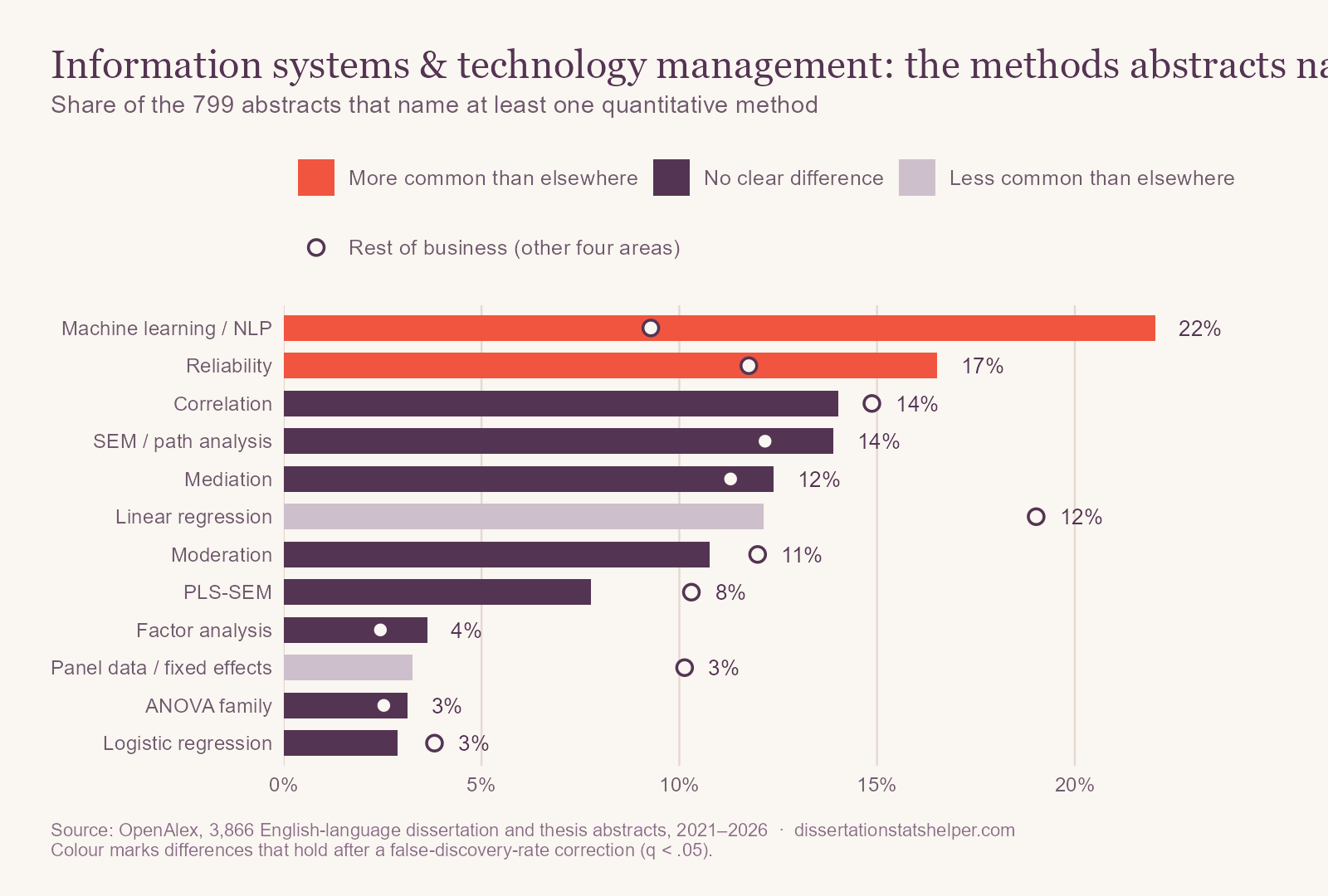 INFORMATION SYSTEMS & TECHNOLOGY MANAGEMENTWhat statistics do information systems and technology management dissertations and theses use?
Information systems and technology management dissertations name machine learning more than any other method, alongside survey models of technology adoption. A look at 3,866 abstracts since 2021.
Read the breakdownSERIES · DISSERTATION WRITING GUIDES
Write it the way
your committee expects.
Practical guides to the parts of a dissertation that committees, reviewers, and search engines read first, checked against real dissertations.
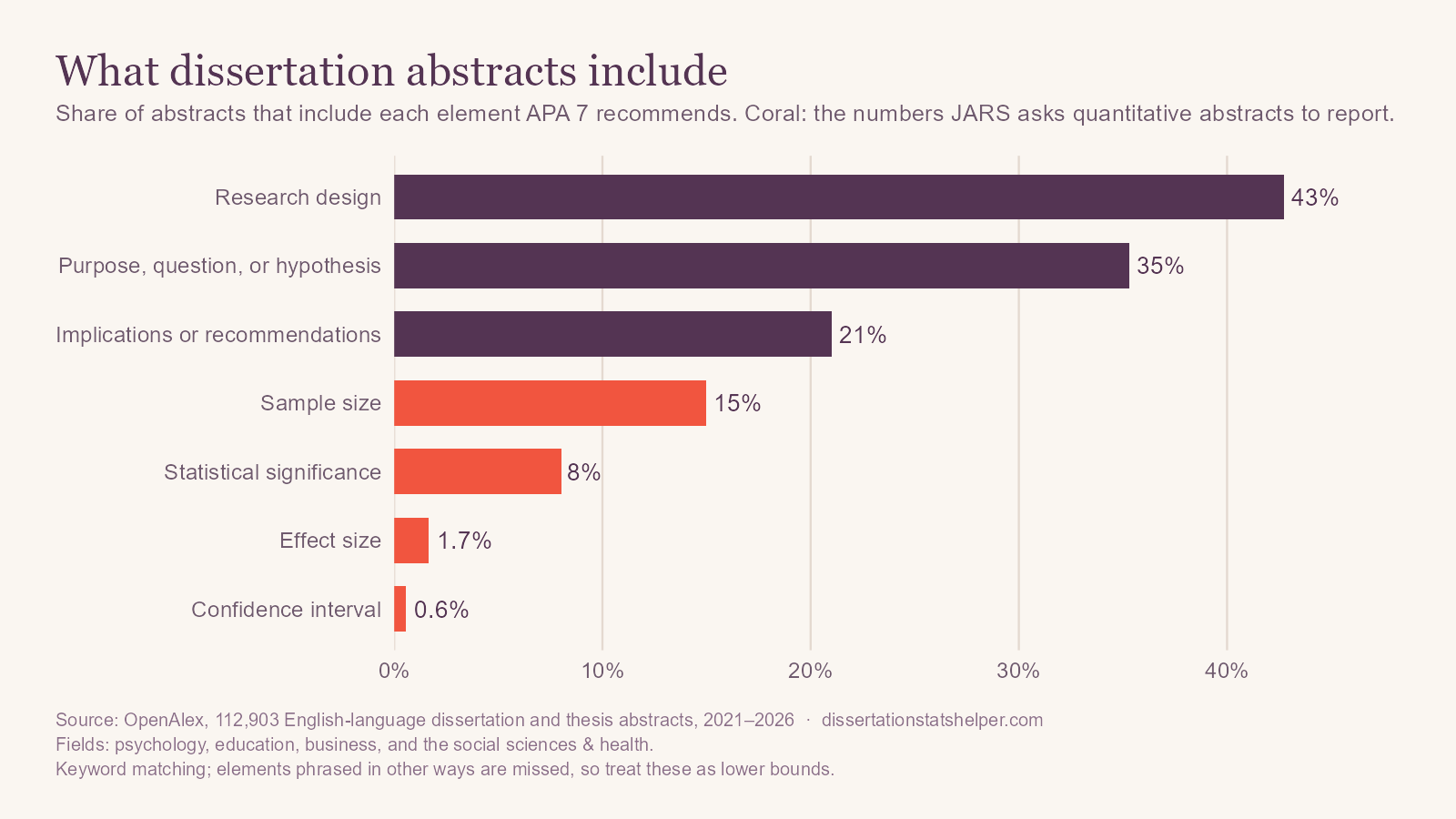
APA asks an abstract for the problem, the method, the results, and what they mean, in about 250 words. We checked 112,903 recent dissertation and thesis abstracts against that list. Most leave out the numbers.
Read the overview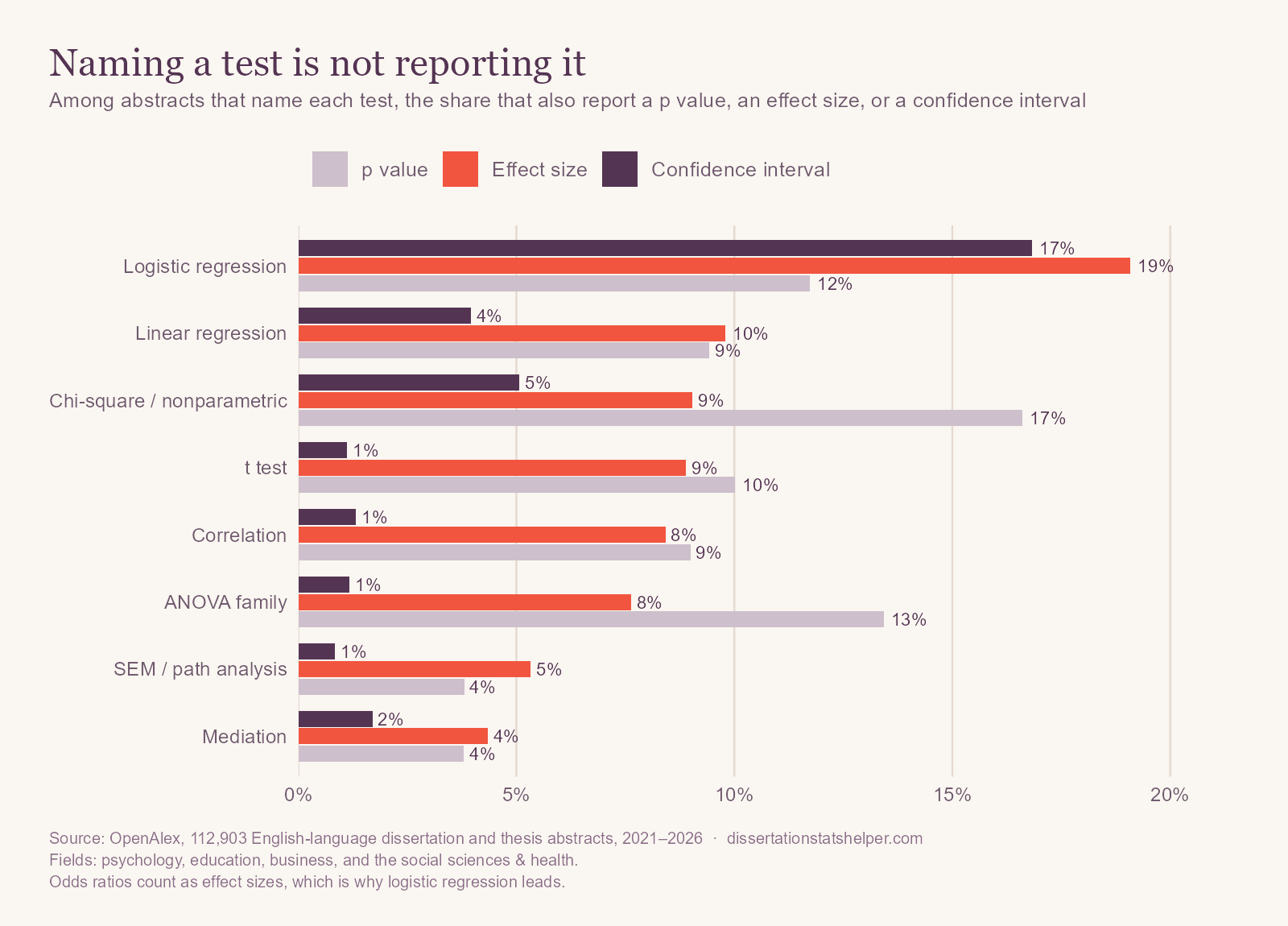 THE RESULTS CHAPTERHow to write the results chapter of a dissertation (APA 7)
The results chapter reports what you found, question by question, with the numbers a reader needs to judge it. Here is what APA 7 and its reporting standards ask for, how to format the statistics, and example write-ups you can adapt.
Read the breakdown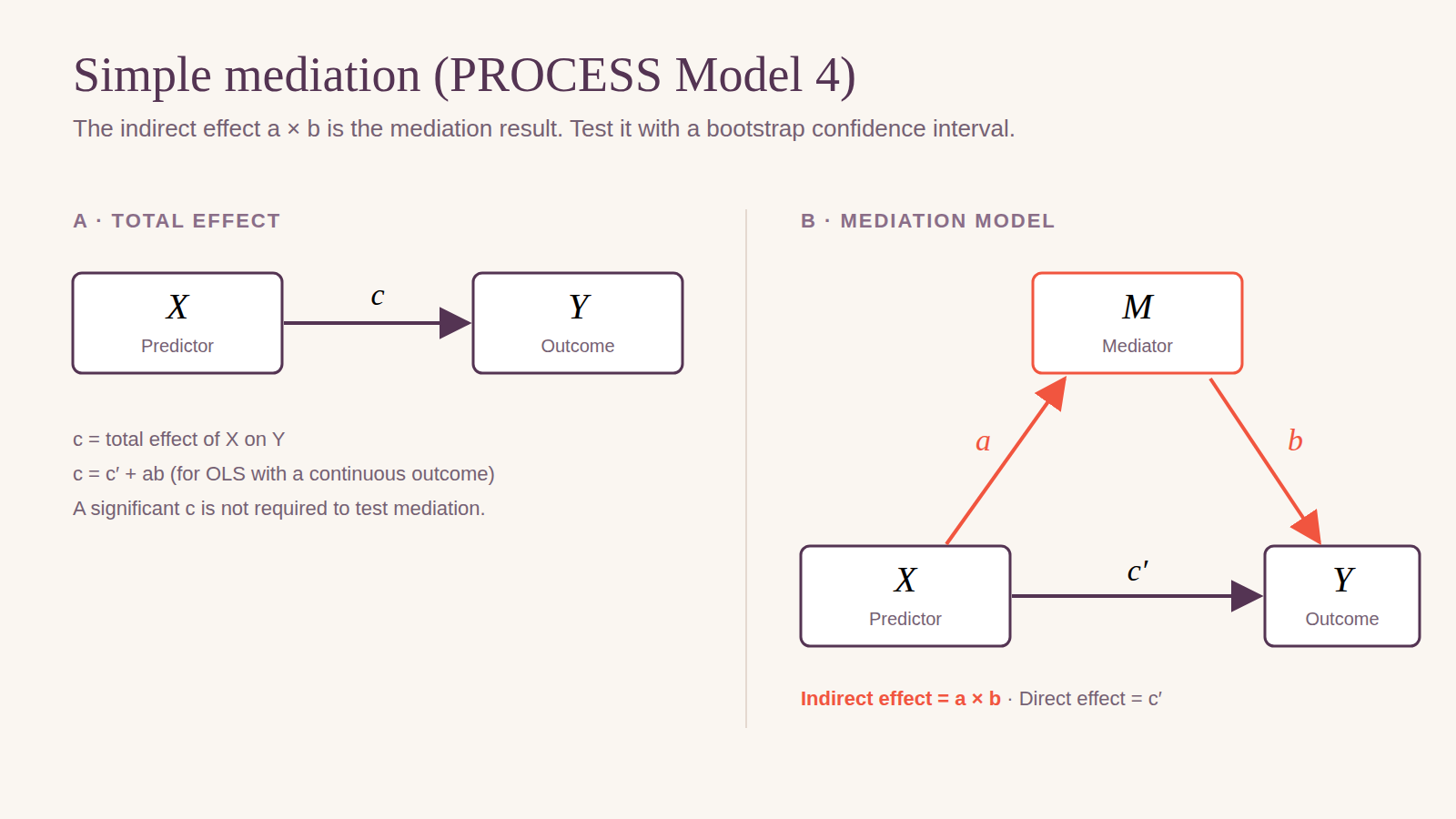 MEDIATION WITH PROCESSMediation with Hayes PROCESS Model 4: how to run it, read it, and report it in APA 7
Mediation is one of the most common analyses in psychology, education, and business dissertations, and one of the least completely reported. Here is how to run Hayes PROCESS Model 4, what each part of the output means, and how to write it up so your committee can check it.
Read the breakdown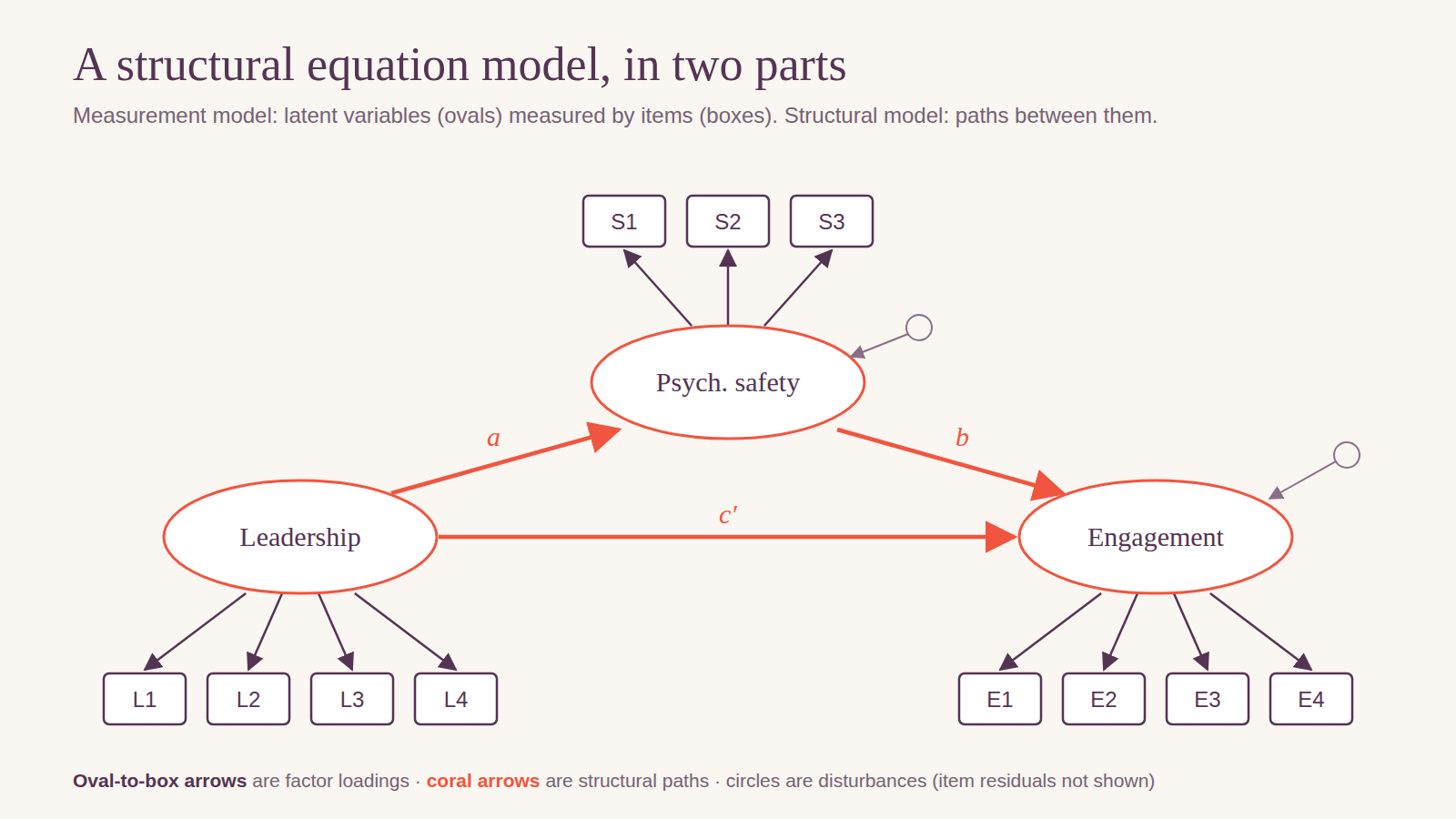 STRUCTURAL EQUATION MODELINGStructural equation modeling for your dissertation: from measurement model to APA 7 write-up
Structural equation modeling lets you test relationships between constructs while accounting for how they were measured. It also gives a committee more to question than almost any other method. Here is how to plan it, run it, judge its fit, and report it.
Read the breakdown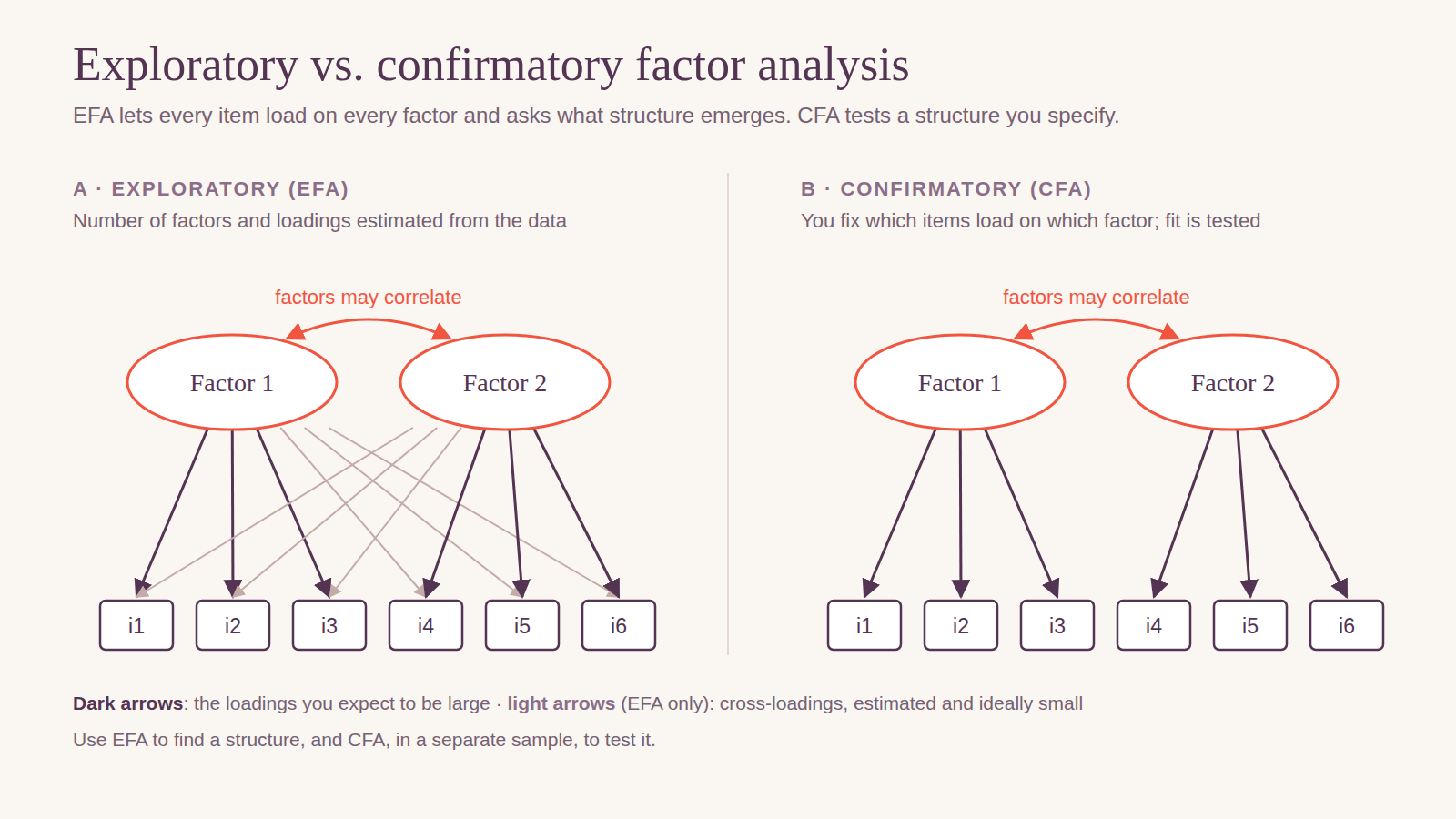 EFA AND CFAExploratory and confirmatory factor analysis for your dissertation: EFA vs. CFA, step by step
Almost every survey-based dissertation has to show that its scales measure what they claim to. Factor analysis is how. Here is when to use exploratory or confirmatory factor analysis, the decisions each one involves, and how to report them.
Read the breakdown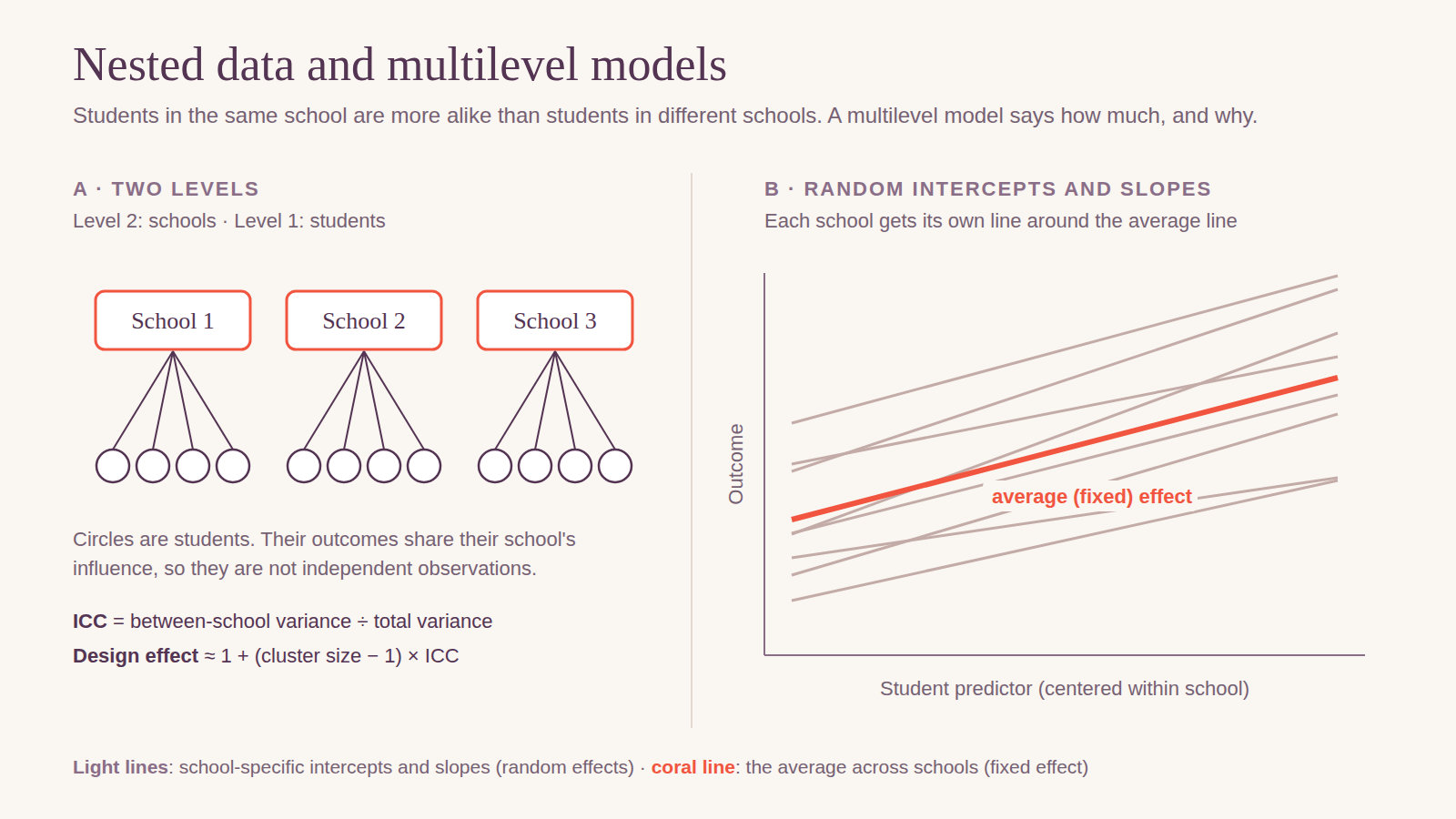 MULTILEVEL MODELS (HLM)Multilevel modeling (HLM) for your dissertation: nested data, step by step
Students in schools, employees in teams, patients in clinics, and days within people: when your data are nested, ordinary regression gives standard errors that are too small. Here is how to build a multilevel model step by step and report it so your committee can follow it.
Read the breakdown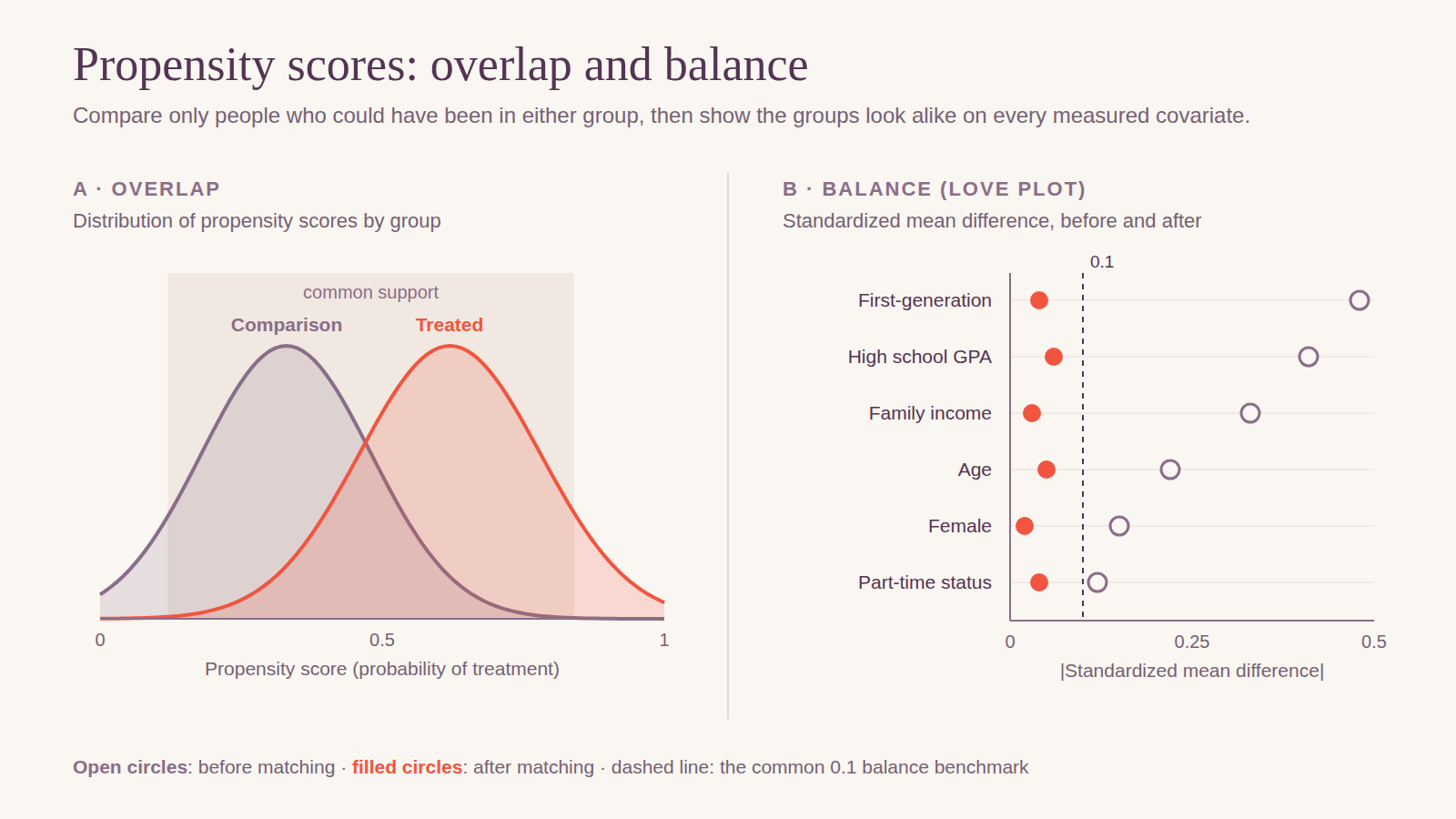 PROPENSITY SCORE MATCHINGPropensity score matching for your dissertation: balance, estimands, and APA 7 reporting
When you can’t randomize, propensity scores let you compare people who received a program with similar people who didn’t. They can’t fix confounders you didn’t measure, and committees know it. Here is how to do it carefully and report it honestly.
Read the breakdown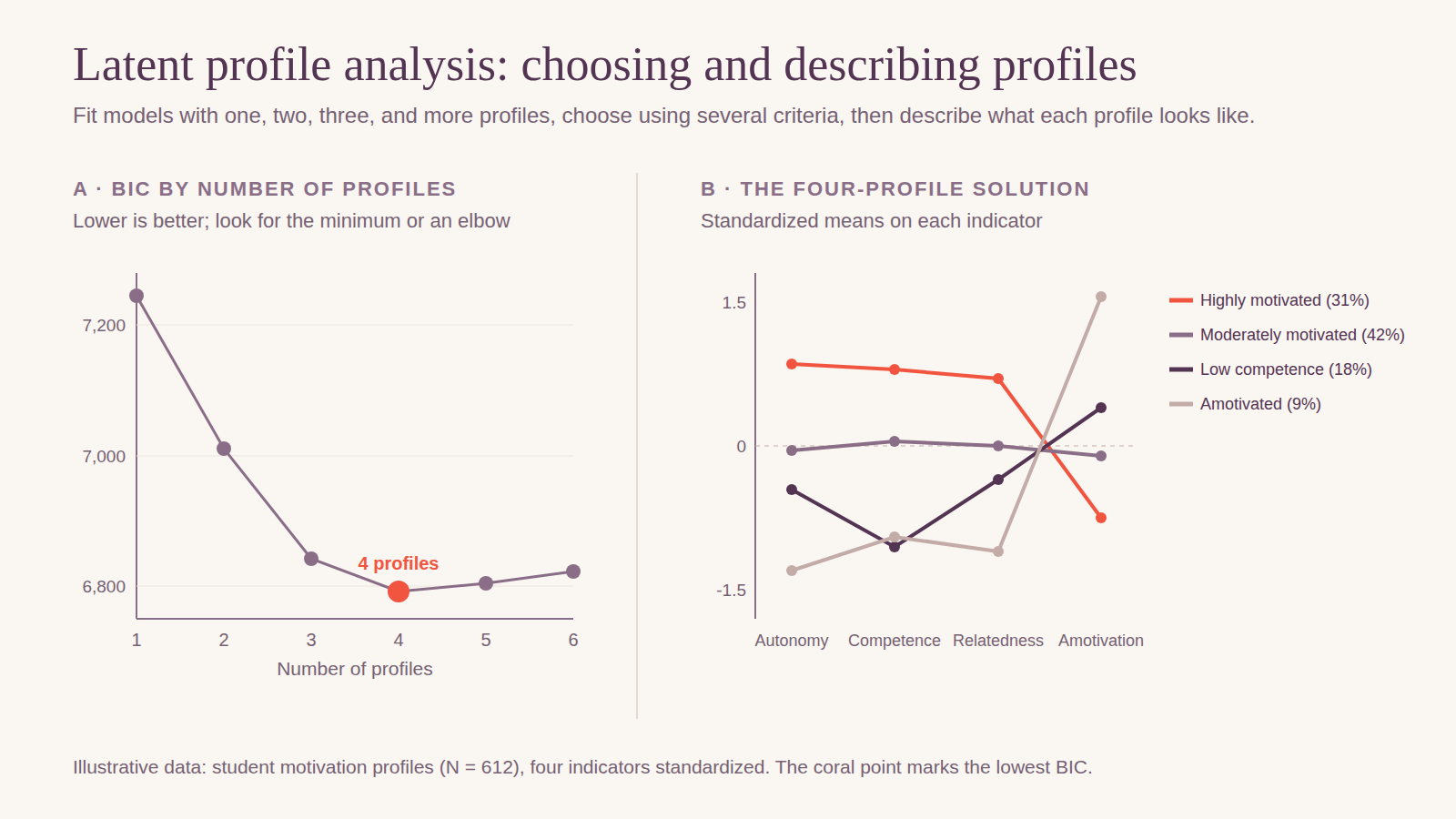 LATENT PROFILE ANALYSISLatent profile and latent class analysis for your dissertation: choosing the number of profiles and reporting them
Latent profile and latent class analysis find subgroups of people who share a pattern of responses. Choosing how many subgroups there are is the hardest part, and the part committees question most. Here is how to do it defensibly and report it clearly.
Read the breakdown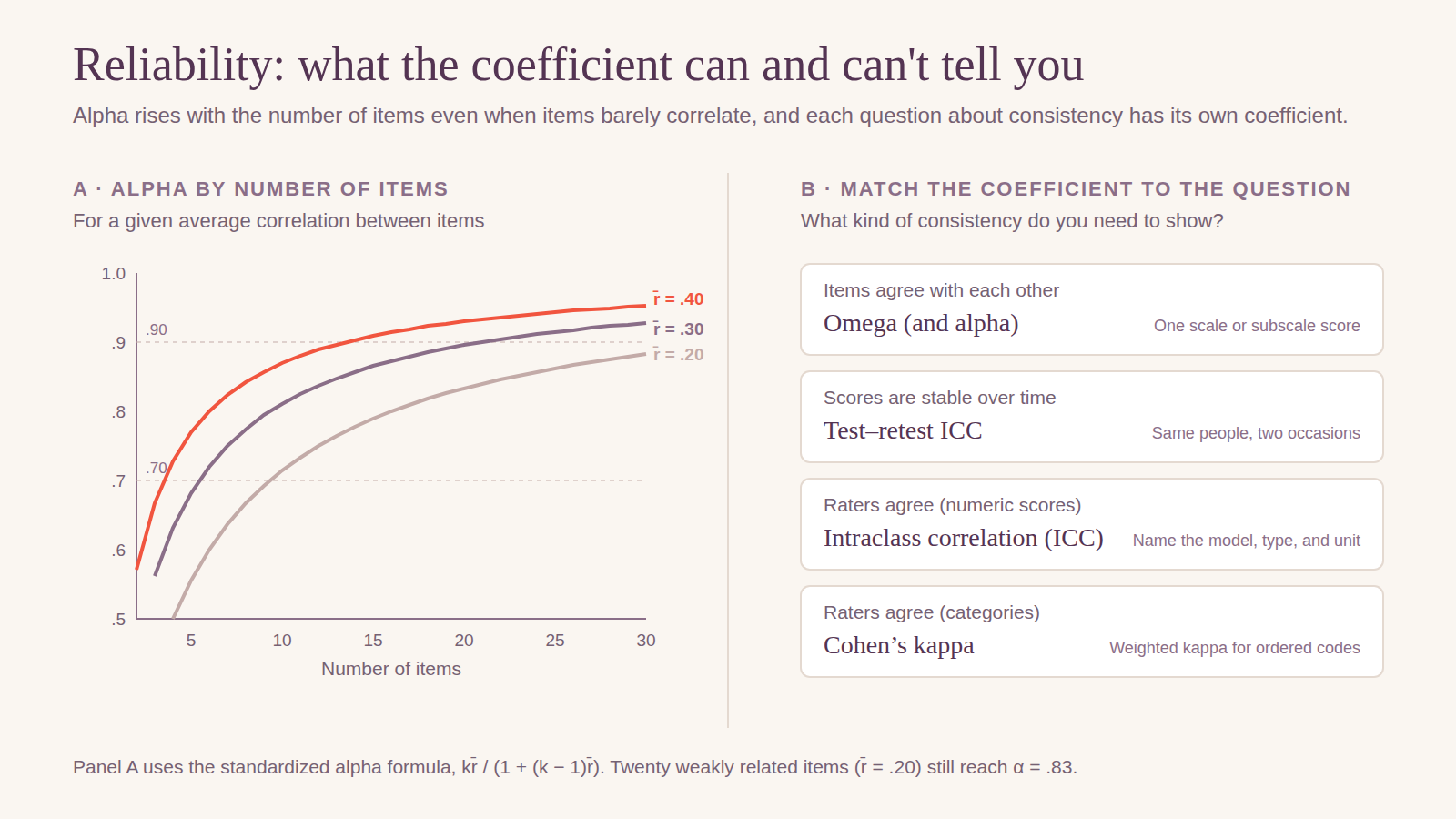 RELIABILITYReliability analysis for your dissertation: alpha, omega, ICC, and kappa
Nearly every dissertation with a survey or a coding scheme reports reliability, usually as a single Cronbach’s alpha. Committees increasingly ask for more. Here is how to choose the right coefficient, what alpha can and can’t tell you, and how to report reliability properly.
Read the breakdownPLANNING YOUR ANALYSIS?
Bring your design.
We'll work through it.
A short consultation can help you choose methods that fit your question, your data, and your committee's expectations, before you collect data or while you write up.
Book a free consultation
SERIES · METHODS IN SOCIAL SCIENCE AND HEALTH DISSERTATIONS AND THESES
What social science and health
dissertations actually use.
What 50,799 recent abstracts in sociology, political science, economics, public health, nursing, and communication say about the statistics students use.
We analyzed 50,799 dissertation and thesis abstracts in sociology, political science, economics, public health, nursing and health professions, and communication. Six fields, three toolkits, and one habit they share: almost nobody mentions a power analysis.
Read the overview →Sociology is the largest field in our data and one of the least quantitative. When sociology abstracts name a method, mediation and moderation stand out. A look at 22,999 abstracts since 2021.
Read the breakdown →Political science and international relations is the least quantitative field in our data: only 12% of abstracts name a statistical method. Those that do lean on regression, panel data, and text and network methods. A look at 9,301 abstracts since 2021.
Read the breakdown →Economics dissertations are the most quantitative in the social sciences, built on panel data, time series, and causal designs, and all three are growing. A look at 7,087 abstracts since 2021.
Read the breakdown →Public health dissertations name logistic regression twice as often as the other social sciences, along with survival and count models, and they have the most trials and systematic reviews. A look at 3,778 abstracts since 2021.
Read the breakdown →Nursing and health professions dissertations are survey-heavy and outcome-focused: logistic regression, chi-square, correlation, and reliability lead. A look at 5,636 abstracts since 2021.
Read the breakdown →Communication is the most qualitative field in this series, but when its abstracts name a method, mediation leads, and text and network analysis are unusually common. A look at 1,998 abstracts since 2021.
Read the breakdown →