
- abstracts analyzed
- 5,266
- of method-naming abstracts use t tests
- 12%
- use multilevel models
- 4%
In our analysis of 21,308 psychology dissertation and thesis abstracts, developmental and educational psychology has the clearest profile of all: an evaluation-style toolkit of group comparisons and questionnaires, with fewer explanatory models than any other subfield.
What is in this sample
This is less a classic developmental sample than a student-centered one. The most common topics are student stress and coping (a quarter of all abstracts), language acquisition, educational games and gamification, sport psychology, reading and literacy, and second-language learning. It is also the subfield least likely to name a quantitative method: 25% do, and 22% describe qualitative work.
The methods these dissertations name most
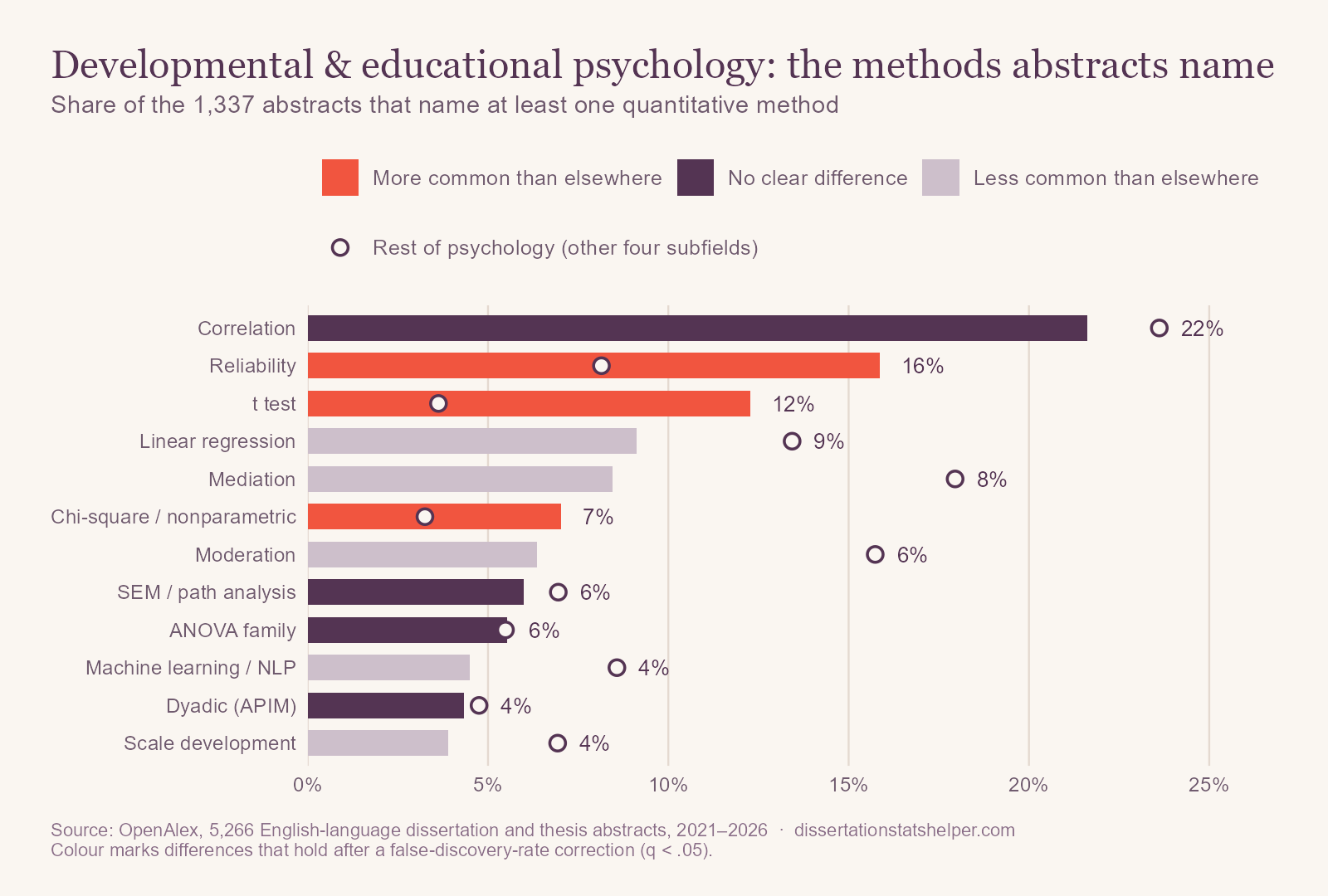
Three methods are clearly more common here than elsewhere:
- Reliability (16% vs. 8%): these dissertations often build or adapt tests and questionnaires for students.
- t tests (12% vs. 4%): mostly pre/post and two-group comparisons of programs and interventions.
- Chi-square and nonparametric tests (7% vs. 3%): comparing groups on categorical outcomes.
Explanatory models are much less common. Mediation appears in 9% of method-naming abstracts (vs. 18% elsewhere), moderation in 6% (vs. 16%), and linear regression in 9% (vs. 13%). Most striking for a field about change and schooling, growth models appear in only 2% and multilevel models in 4%.
What changed since 2021
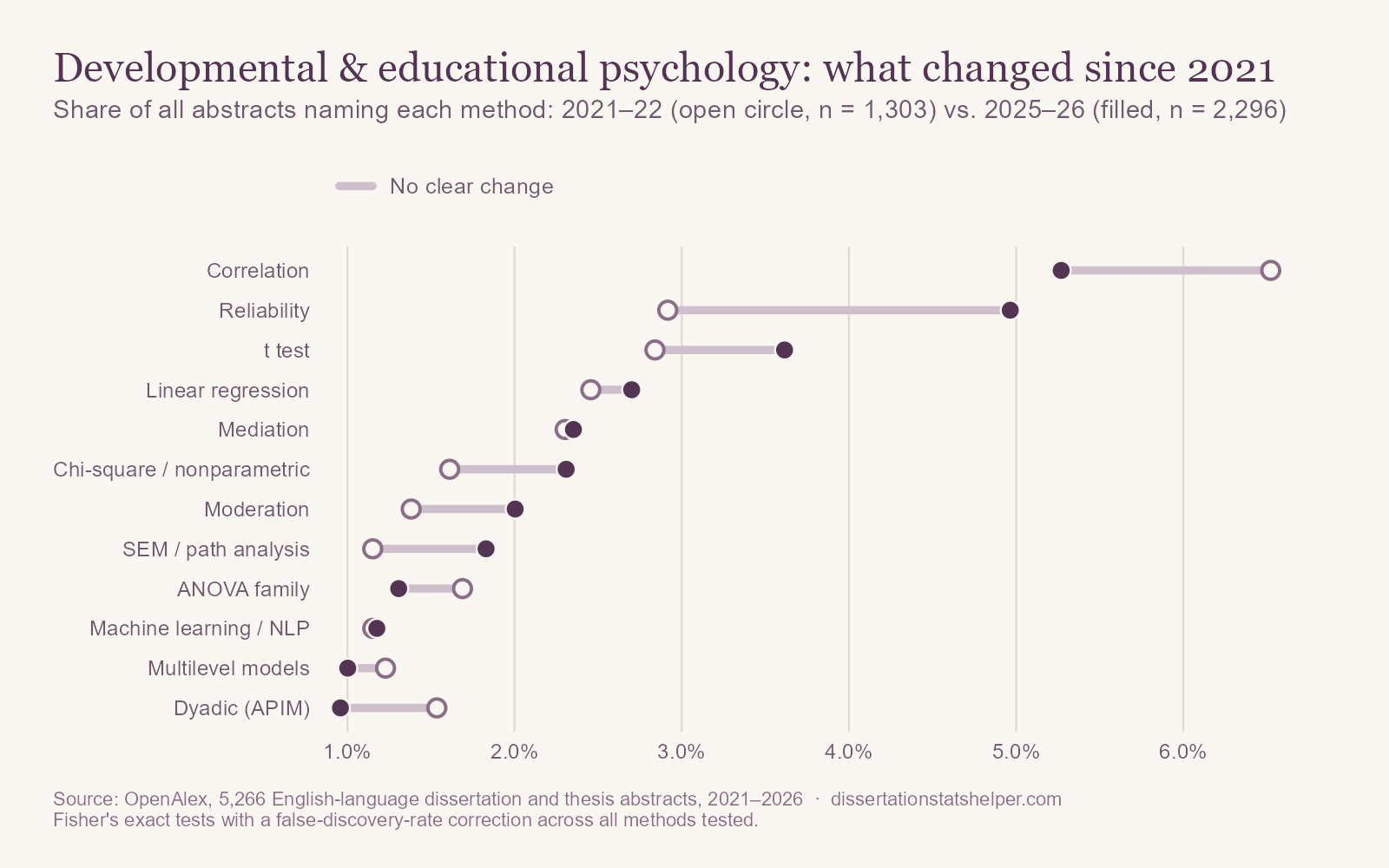
Nothing changed enough to pass our correction for multiple tests. The largest raw move was reliability, from 2.9% to 5.0% of abstracts, matching the rise we see across psychology. The share of abstracts naming any quantitative method held steady at about 26–27%.
What these abstracts leave out
One abstract in 5,266 mentions a power analysis, and two mention missing data. In school-based research, where attrition across a semester is normal and whole classrooms can drop out, the missing-data plan often matters as much as the main analysis.
If you're planning a developmental or educational psychology dissertation or thesis
- Go beyond the t test when you have a comparison group. For pre/post data with a control group, analysis of covariance or a mixed model on the post-test is usually more powerful and easier to defend than separate t tests. Either way, report an effect size with a confidence interval.
- Account for clustering. Students in the same classroom or school are more alike than students chosen at random. Ignoring that makes p-values too small. Use a multilevel model or cluster-robust standard errors, and include the design effect in your power analysis.
- Show your measures work for your students. Report reliability in your own sample. For achievement or skill tests, item response theory can tell you where along the ability range the test measures well.
- Report effect sizes for categorical comparisons. Pair chi-square tests with Cramér's V or odds ratios, and check that expected counts are large enough.
How we did this
We used OpenAlex, an open index of scholarly works, to collect every English-language dissertation and thesis with an abstract published from 2021 through September 2026 in this subfield, kept abstracts longer than 60 words, and searched each title and abstract for about 30 statistical methods. The data include master's theses, so “dissertations” in this post is short for both. Percentages describe how often abstracts mention a method, not how often it was used. Comparisons use Fisher's exact tests with a false-discovery-rate correction, so a difference is only called a difference when it survives testing every method at once. The overview post has the full method and its limitations. The analysis code and result tables are on GitHub.