
- abstracts analyzed
- 6,105
- of method-naming abstracts use mediation
- 19%
- rise in reliability reporting
- 2×
Social psychology is about process: why attitudes shift, how relationships shape well-being, when group identity matters. In our analysis of 21,308 psychology dissertation and thesis abstracts, mediation is named in 19% of method-naming abstracts, second only to correlation.
What is in this sample
The most common topics are LGBTQ health, identity, and policy; human–automation interaction and safety; attachment and relationships; music therapy and health; memory and trauma; access to mental health treatment; and well-being. That mix shows how loosely OpenAlex draws subfield boundaries, since some of these would sit in human factors or health psychology elsewhere. Of the 6,105 abstracts, 31% name a quantitative method and 25% describe qualitative work. Only 5% describe an experiment, which may surprise anyone who knows social psychology from its lab studies. Dissertations lean on surveys instead: 20% mention a survey or questionnaire.
The methods social psychology dissertations name most
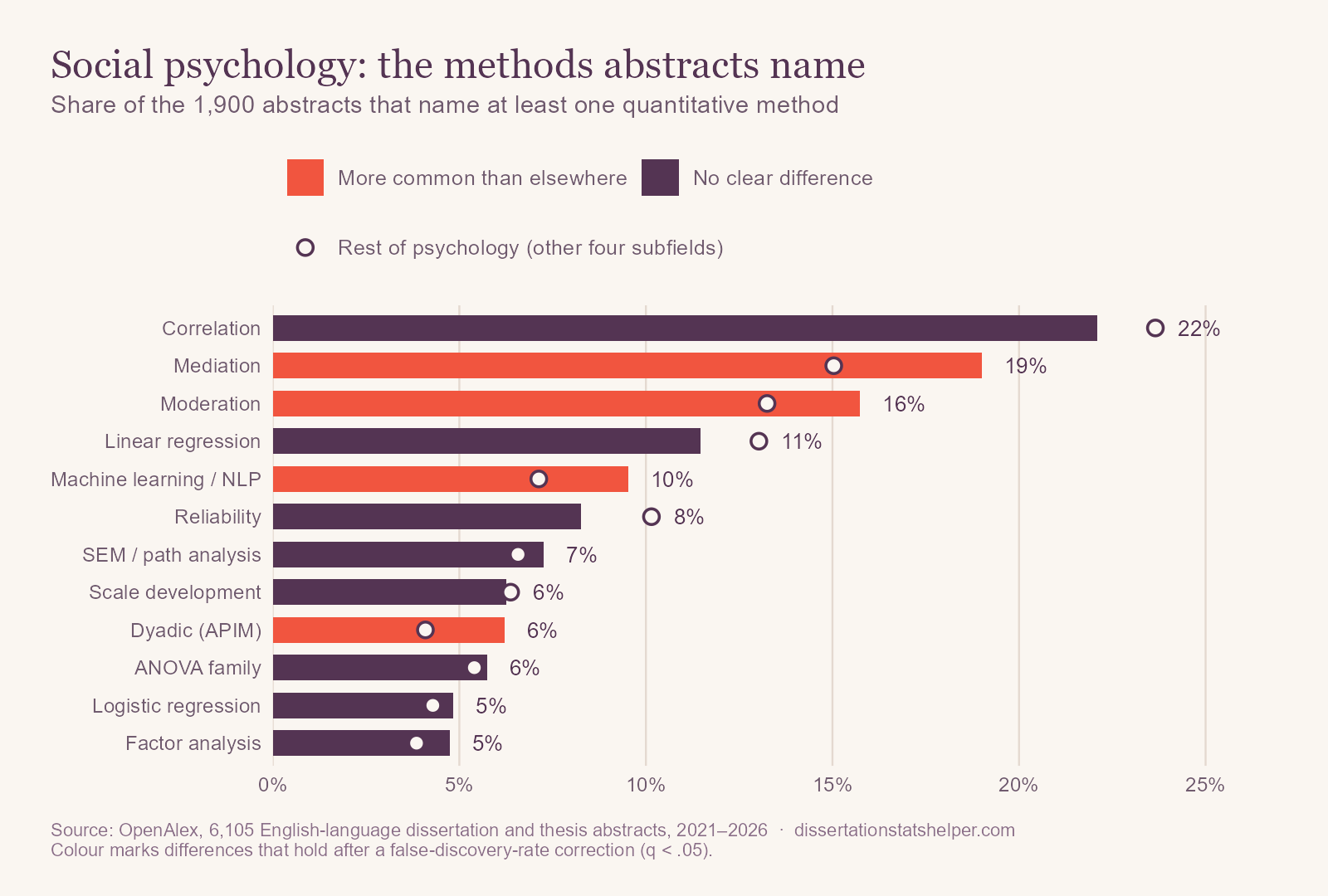
Four methods are clearly more common here than in the other four subfields:
- Mediation (19% vs. 15%), a natural fit for a field built on “why” questions.
- Moderation (16% vs. 13%), for “when” and “for whom” questions.
- Dyadic models (6% vs. 4%), such as the actor–partner interdependence model for couples, friends, or coworkers, where each person's outcome depends on both people.
- Machine learning and natural language processing (10% vs. 7%), often applied to social media text or large online samples.
Group-comparison tests are less common: t tests (3% vs. 6%) and chi-square or nonparametric tests (3% vs. 4%).
What changed since 2021
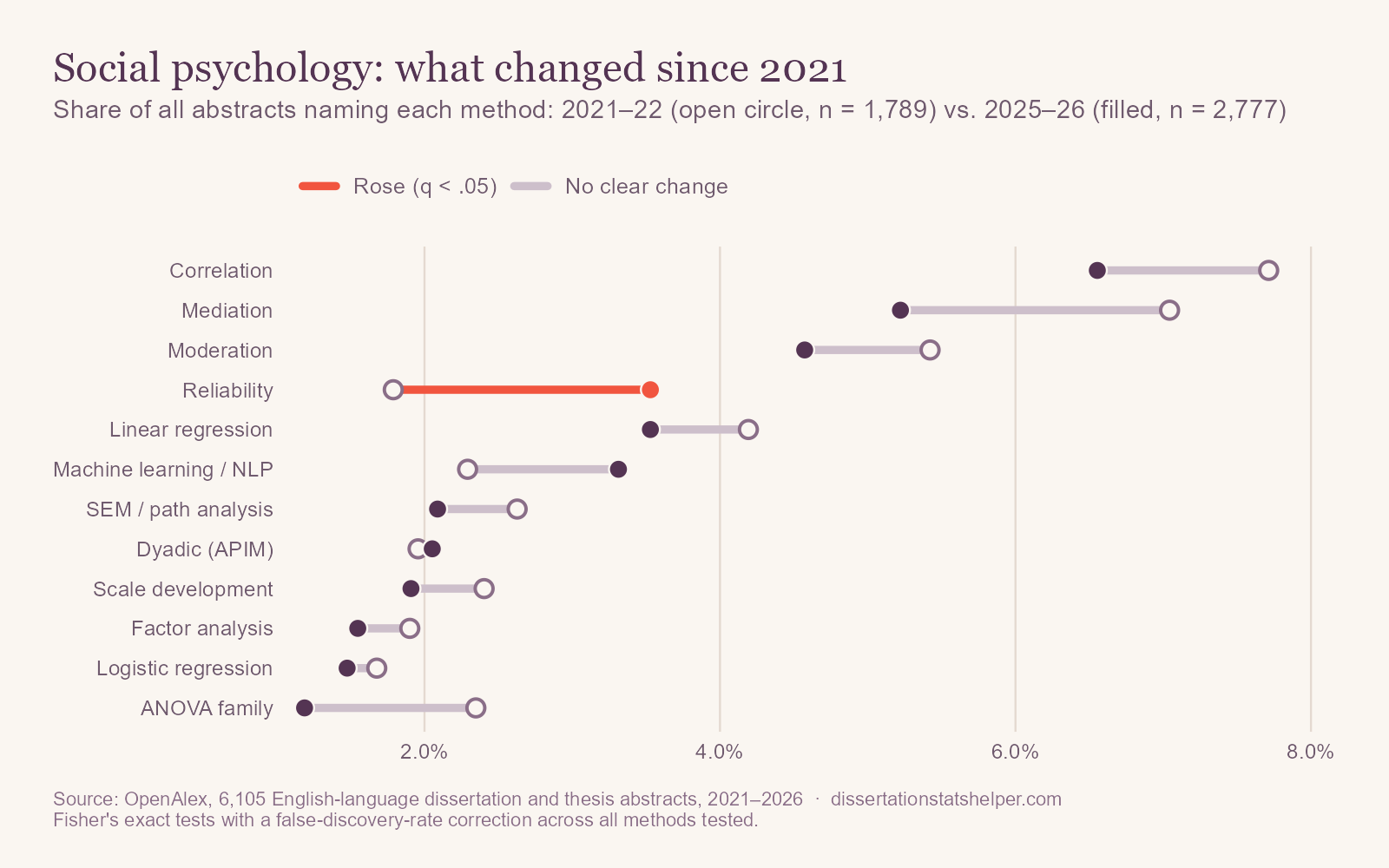
One change holds up: reliability reporting rose from 1.8% of abstracts in 2021–22 to 3.5% in 2025–26 (32 abstracts to 98). ANOVA-family mentions fell from 2.3% to 1.2%, and mediation dipped from 7.0% to 5.2%; both are suggestive but just miss our correction threshold.
What social psychology abstracts leave out
One of 6,105 abstracts mentions a power analysis, and two mention missing data. For a field at the center of the replication debate, that gap is worth noticing. Many journals now expect a sample-size justification, and so do many committees.
If you're planning a social psychology dissertation or thesis
- Match your mediation claim to your design. If you can manipulate the predictor, do; that makes the first path causal. With a single survey, report the bootstrap confidence interval for the indirect effect and describe the result as consistent with a mechanism, not proof of one.
- Treat dyads as dyads. Partners' scores are not independent. Use a dyadic model, decide whether members are distinguishable, and count dyads, not people, when you plan power.
- Report reliability for every scale. It is increasingly visible, even in abstracts.
- Validate text and machine learning models. Keep a held-out test set, compare against a simple baseline, and report performance on data the model never saw.
How we did this
We used OpenAlex, an open index of scholarly works, to collect every English-language dissertation and thesis with an abstract published from 2021 through September 2026 in this subfield, kept abstracts longer than 60 words, and searched each title and abstract for about 30 statistical methods. The data include master's theses, so “dissertations” in this post is short for both. Percentages describe how often abstracts mention a method, not how often it was used. Comparisons use Fisher's exact tests with a false-discovery-rate correction, so a difference is only called a difference when it survives testing every method at once. The overview post has the full method and its limitations. The analysis code and result tables are on GitHub.