
- abstracts analyzed
- 21,308
- name a quantitative method
- 33%
- of those mention mediation
- 16%
Which statistical methods do psychology dissertations actually use? Methods courses give one answer. The dissertations and theses themselves give another. We collected every English-language psychology dissertation and master's thesis with an abstract published since 2021 in the five largest subfields (21,308 abstracts) and counted which methods they name. Below, “dissertations” is short for both.
This post is the overview. Each subfield has its own breakdown: clinical, social, developmental and educational, experimental and cognitive, and applied.
Most abstracts don't name a method at all
Only a third of abstracts (6,935, or 33%) name a quantitative method. Another 23% describe qualitative work: thematic analysis, interpretative phenomenological analysis, grounded theory, or interviews. About 6% describe an experiment or randomized design, and 4% are systematic reviews or meta-analyses. Many of the rest describe a quantitative study without naming the analysis.
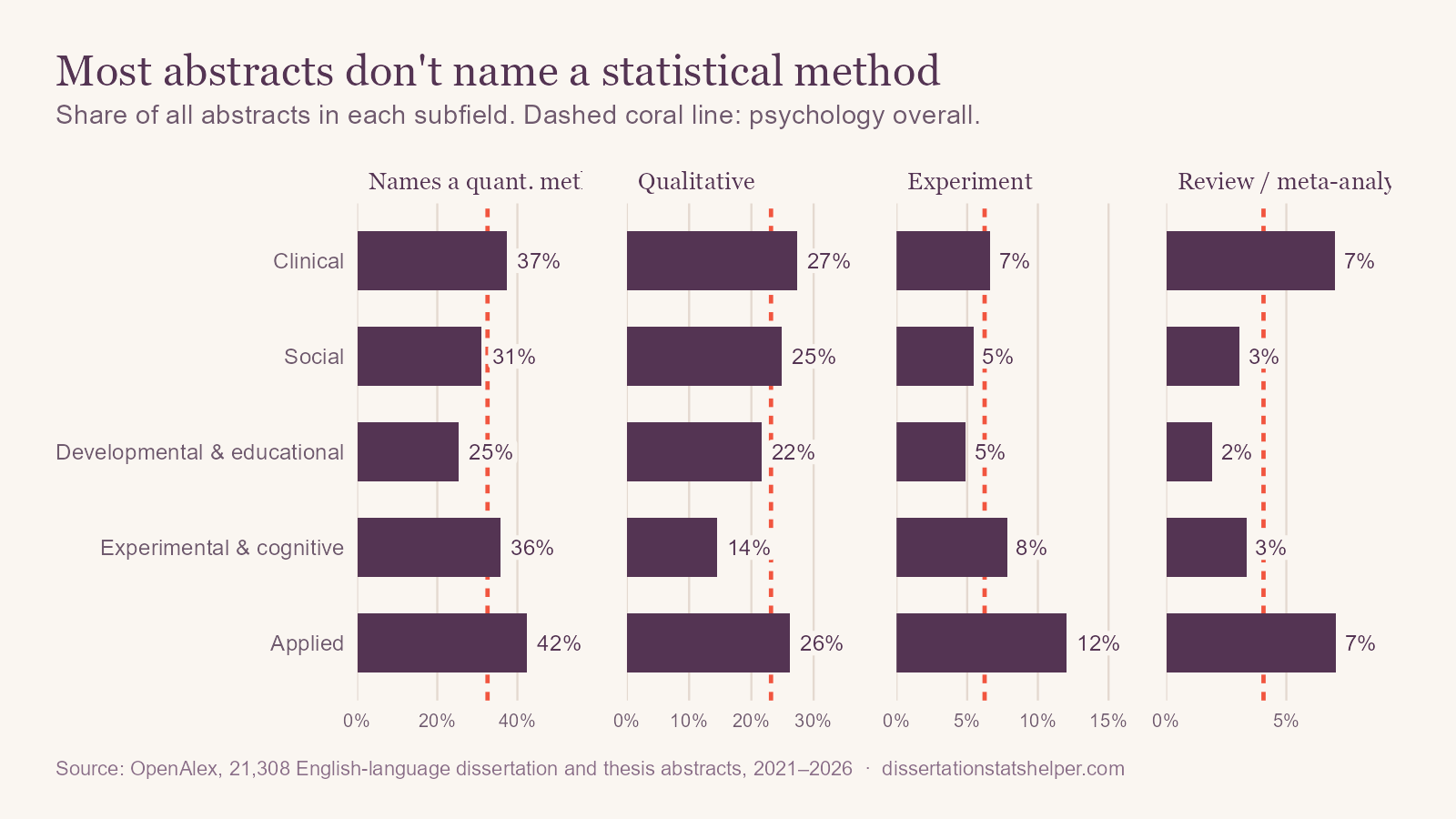
The subfields differ more than you might expect. Applied psychology abstracts name a quantitative method most often (42%); developmental and educational abstracts least often (25%). Experimental and cognitive psychology has the smallest share of qualitative work (14%). If you use published dissertations as models for your own, remember that an abstract tells you the question and the finding far more reliably than the analysis.
The methods psychology dissertations name most
Among the 6,935 abstracts that name a method, correlation leads, followed by mediation and moderation:
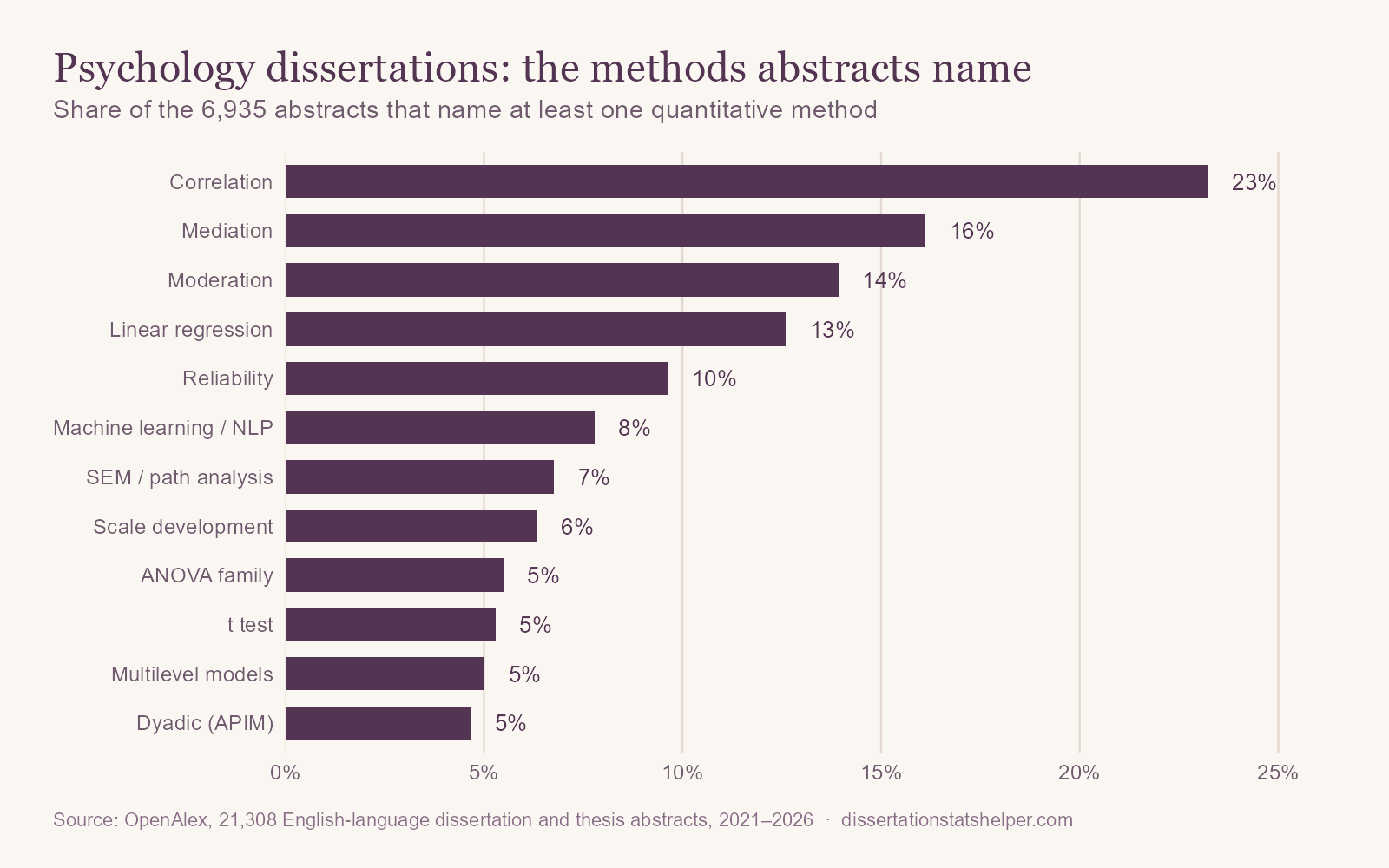
Three things stand out. Correlation and regression are still the foundation of most quantitative dissertations. Mediation (16%) and moderation (14%) are the most common ways students go beyond a simple association, far more common than structural equation models (7%) or multilevel models (5%). And classic group comparisons (ANOVA, t tests, chi-square) appear less often than their place in a first statistics course would suggest, partly because experiments are a minority design.
Each subfield has its own fingerprint
Split by subfield, the same list looks quite different. The outlined cells are methods that are clearly more common in that subfield than in the other four combined.
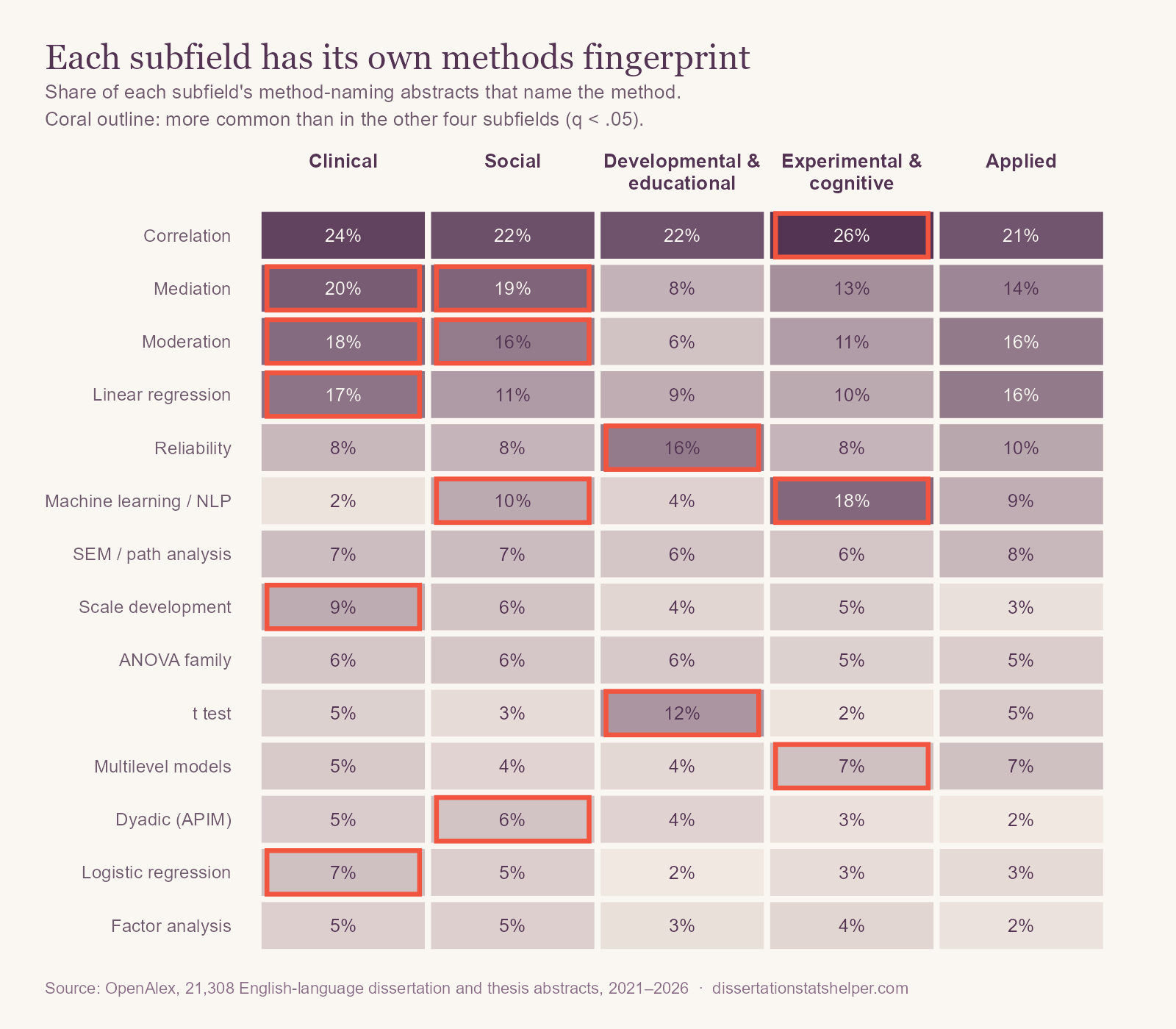
- Clinical leans on explanatory models: mediation (20%), moderation (18%), and linear regression (17%) are all more common than elsewhere, and so are scale development and logistic regression.
- Social names mediation (19%) and moderation (16%) more often than the rest of psychology, and dyadic models for couples and relationships stand out too.
- Developmental and educational has an evaluation profile: reliability (16%) is twice as common as elsewhere and t tests (12%) three times as common, while mediation and moderation are less than half as common.
- Experimental and cognitive names machine learning in 18% of method-naming abstracts, more than three times the rate elsewhere, along with network analysis and Bayesian methods.
- Applied psychology shows no difference that survives correction. With 300 method-naming abstracts, it is simply too small to tell.
What changed since 2021
Comparing abstracts from 2021–2022 (6,172) with 2025–2026 (9,335), a handful of changes hold up after correcting for testing about 30 methods at once:
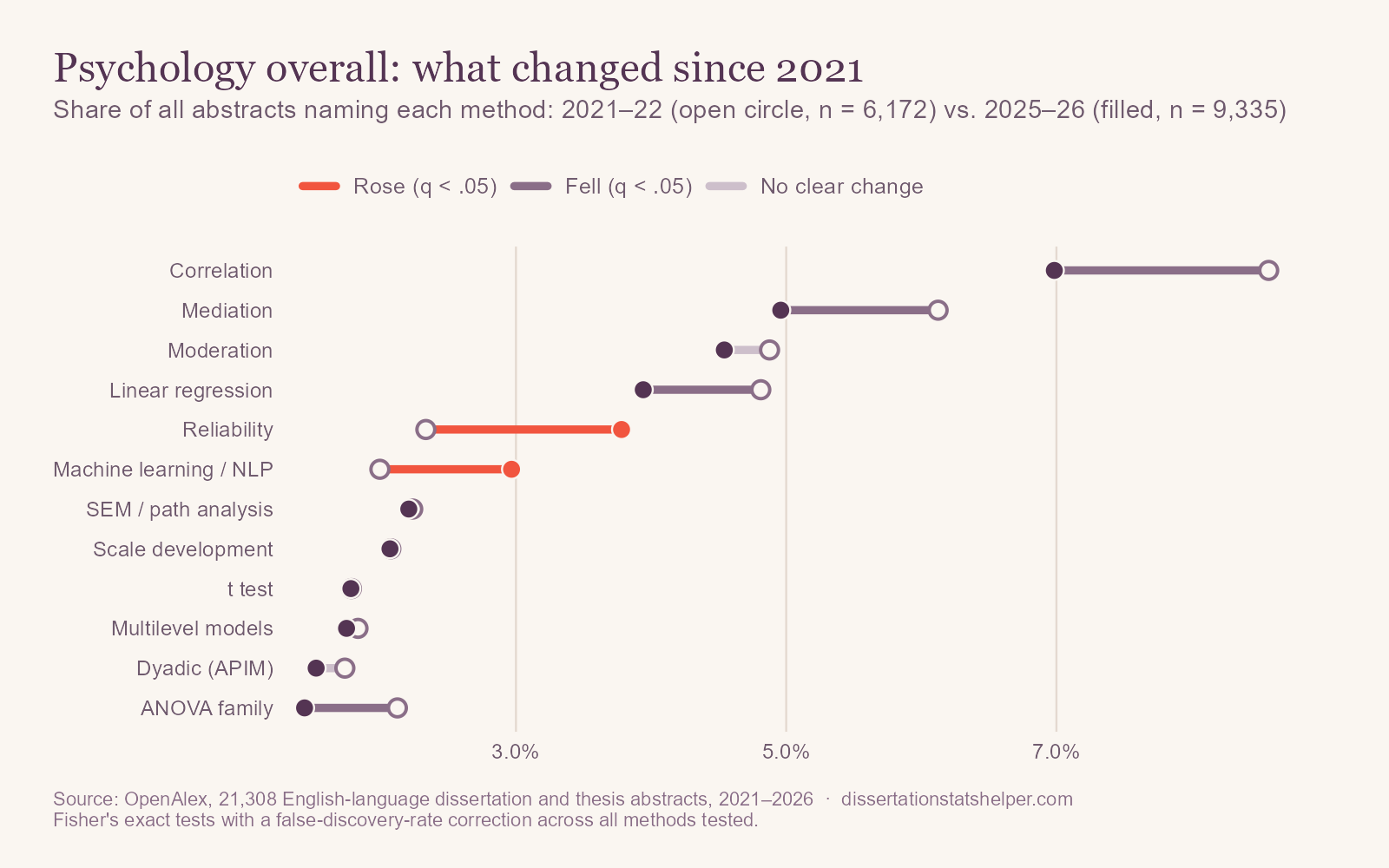
- Rising: reliability reporting (2.3% to 3.8% of all abstracts), machine learning and natural language processing (2.0% to 3.0%), and text analysis such as sentiment or topic models (10 abstracts to 39, still rare).
- Falling: correlation (8.6% to 7.0%), mediation (6.1% to 5.0%), linear regression (4.8% to 3.9%), the ANOVA family (2.1% to 1.4%), and logistic regression (1.9% to 1.4%).
- Not clear yet: latent profile analysis (29 abstracts to 70), psychometric network analysis (34 to 72), and growth-curve and time-series models all rose, but not by enough to rule out chance once every method is tested.
Part of these falls reflects a small drop in the share of abstracts naming any quantitative method (35% to 33%), but the declines in correlation and mediation are larger than that. Abstracts can't tell us why; one possibility is that authors increasingly name the model they built rather than the analyses they started from.
What abstracts leave out
Only 4 of 21,308 abstracts mention a power analysis, and 18 mention how missing data were handled. That doesn't mean these studies skipped them. It means abstracts report questions and findings, not the decisions that make the findings trustworthy. Those decisions are exactly what committees and reviewers ask about, so they belong in your methods chapter even though they will never make your abstract.
That fits APA’s own guidance. Its reporting standards ask a quantitative abstract for the research design, sample size, measures, and findings with effect sizes, not the name of the statistical test or the power analysis; those belong in the Method section. Our guide to writing a dissertation abstract covers what to include, with data on what real abstracts leave out.
What this means if you're planning a dissertation or thesis
- Get the foundations right. Correlations, regression, and group comparisons carry most quantitative dissertations. Report them with effect sizes and confidence intervals, not only p-values.
- Treat mediation with care. It is the most common advanced analysis and the one most often over-interpreted. A significant indirect effect in cross-sectional data is not evidence of a causal chain.
- Report reliability for every scale. It is increasingly expected and easy to include.
- Write down your power analysis and missing-data plan. They are invisible in abstracts and central to your defense. Our free power planning hub is a place to start.
- Read your own subfield's fingerprint. What counts as a standard analysis differs across psychology, and so will your committee's expectations.
Read the subfield breakdowns
- Clinical psychology: mediation, moderation, and regression lead; power analysis appears in none of 5,876 abstracts.
- Social psychology: mediation, moderation, and dyads, and reliability reporting has doubled.
- Developmental and educational psychology: t tests, reliability, and a multilevel gap.
- Experimental and cognitive psychology: machine learning, networks, and Bayesian methods.
- Applied psychology: intervention research in a small sample.
How we did this
We used OpenAlex, an open index of scholarly works, to collect every English-language work typed as a dissertation or thesis, with an abstract, published from 2021 through September 2026, in the five largest psychology subfields: clinical, social, developmental and educational, experimental and cognitive, and applied. Neuropsychology (186 works) and general psychology (36) were too small to include. We kept the 21,308 abstracts longer than 60 words, dropped a handful of records with impossible future dates, and searched each title and abstract for about 30 statistical methods using a keyword dictionary that we spot-checked for false matches. We tightened the dictionary on September 27, 2026, after spot checks across fields showed that broad patterns counted phrases such as “computer-mediated” as mediation and everyday uses of “trajectory” as growth models; the numbers here use the tightened version.
Keep four limitations in mind. First, percentages describe how often abstracts mention a method, which is not the same as how often it was used. Second, OpenAlex assigns subfields with an algorithm that reads the text, so the boundaries are loose; experimental and cognitive psychology, for example, includes engineering theses on emotion recognition and sleep staging. Third, the data include master's theses and dissertations from outside the United States. Fourth, keyword matching misses some methods and misclassifies a few mentions. Comparisons between subfields and periods use Fisher's exact tests with a Benjamini–Hochberg false-discovery-rate correction across all methods tested. Treat the numbers as a reliable picture of the broad pattern rather than precise rates.
The analysis code, the method dictionary, and the result tables behind every number here are on GitHub, under the MIT License.