
- run past APA’s 250 words
- 49%
- report a sample size
- 15%
- report an effect size
- 1.7%
The abstract is the most-read part of your dissertation. Committee members read it first, ProQuest and your library index it, and search engines show it to everyone who never opens the PDF. It is also the part most often written last, in a hurry.
This guide covers what APA 7 asks an abstract to include, what its reporting standards add for quantitative studies, how long a dissertation abstract should be, and what 112,903 real dissertation and thesis abstracts actually include. It ends with a template and a checklist.
What APA 7 asks for
APA describes the abstract as a brief, comprehensive summary that helps readers decide whether to read the full work. It suggests a sentence or two on each of these:
- The problem or research question, with just enough background to show why it matters.
- Your hypotheses, if you tested any.
- Your method: the study design, the sample, and the sample size.
- Your results.
- The implications: why the findings matter and how they can be used.
Format it as a single, unindented paragraph under the bold, centered label “Abstract,” and follow it with three to five keywords that describe your topic, population, and method. APA's general limit is 250 words unless your institution or journal sets another.
What the reporting standards add for quantitative studies
APA's Journal Article Reporting Standards for quantitative research (JARS–Quant) are more specific. For the abstract, they ask you to describe:
- the research design (for example, an experiment or an observational study);
- the sample size and the participants' key characteristics;
- the instruments or materials and the outcome measures;
- how the data were gathered, including the source of any secondary data;
- the findings, with effect sizes and confidence intervals or significance levels;
- conclusions and implications beyond the results themselves.
Notice what is not on the list: the name of the statistical test, the software, the power analysis, and how missing data were handled. Those belong in the Method section. Qualitative studies follow JARS–Qual, which does ask the abstract to name the analytic strategy, along with the types of participants or data sources, the main findings, and their implications, and suggests five keywords, including one for the method. Mixed-methods studies have their own standards too.
How long should a dissertation abstract be?
Your graduate school's formatting guide comes first, and many set their own limit. If yours doesn't, two numbers are worth knowing. APA's default is 250 words. ProQuest, which distributes most US dissertations, shortens abstracts to 350 words for doctoral dissertations and 150 for master's theses in its print indexes, but publishes the full abstract online.
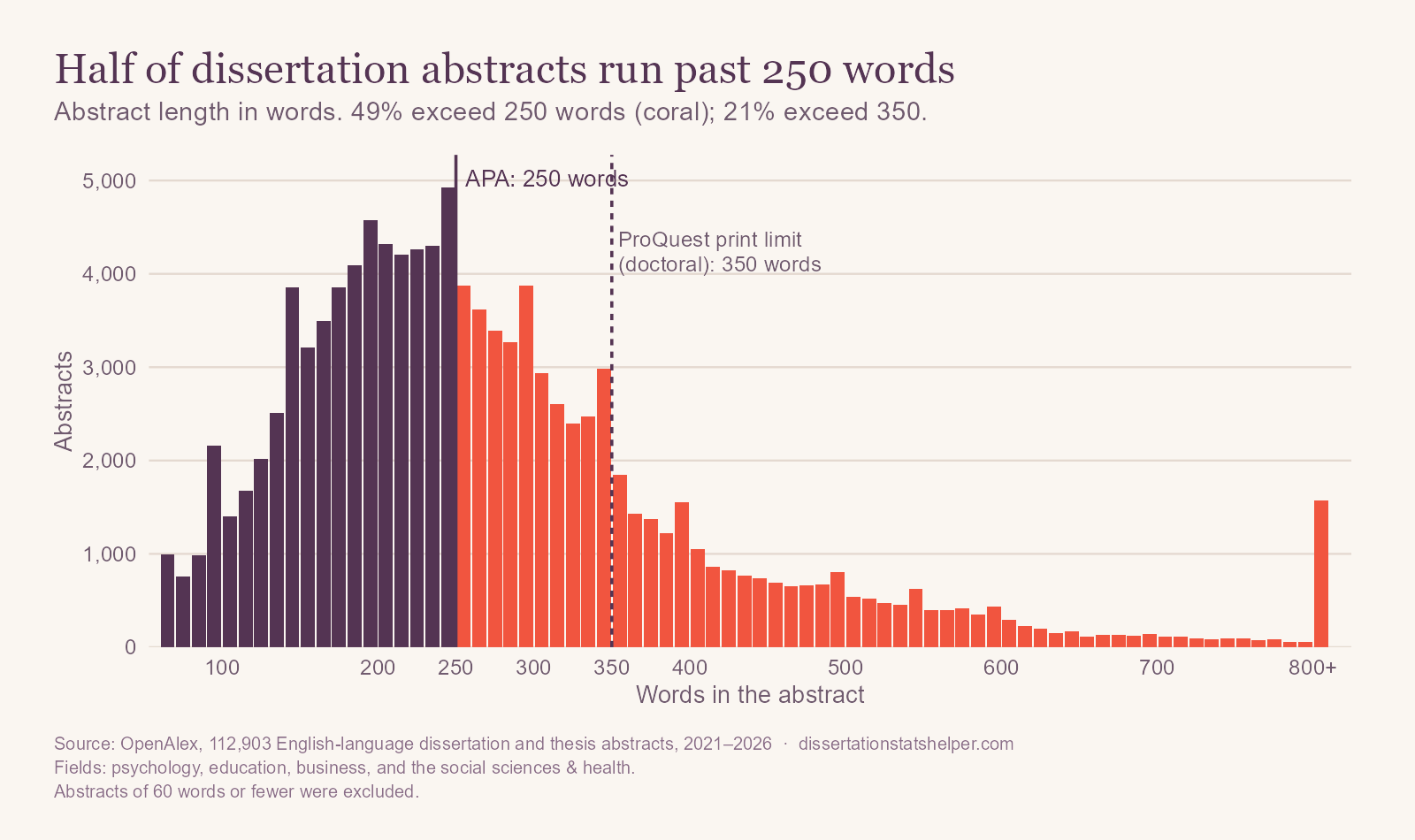
In our data, the typical abstract runs about 250 words, and half go over. About one in five exceeds 350. The histogram also shows writers trimming to a limit: 4,925 abstracts fall between 241 and 250 words, compared with 3,873 between 251 and 260, and there are similar bumps just under 150 and 350 words. A small tail runs past 800 words, often front matter that was indexed as the abstract.
What 112,903 real abstracts include
We searched every English-language dissertation and thesis abstract published since 2021 in psychology, education, business, and the social sciences and health (the same data as our methods series) for the elements APA asks for.
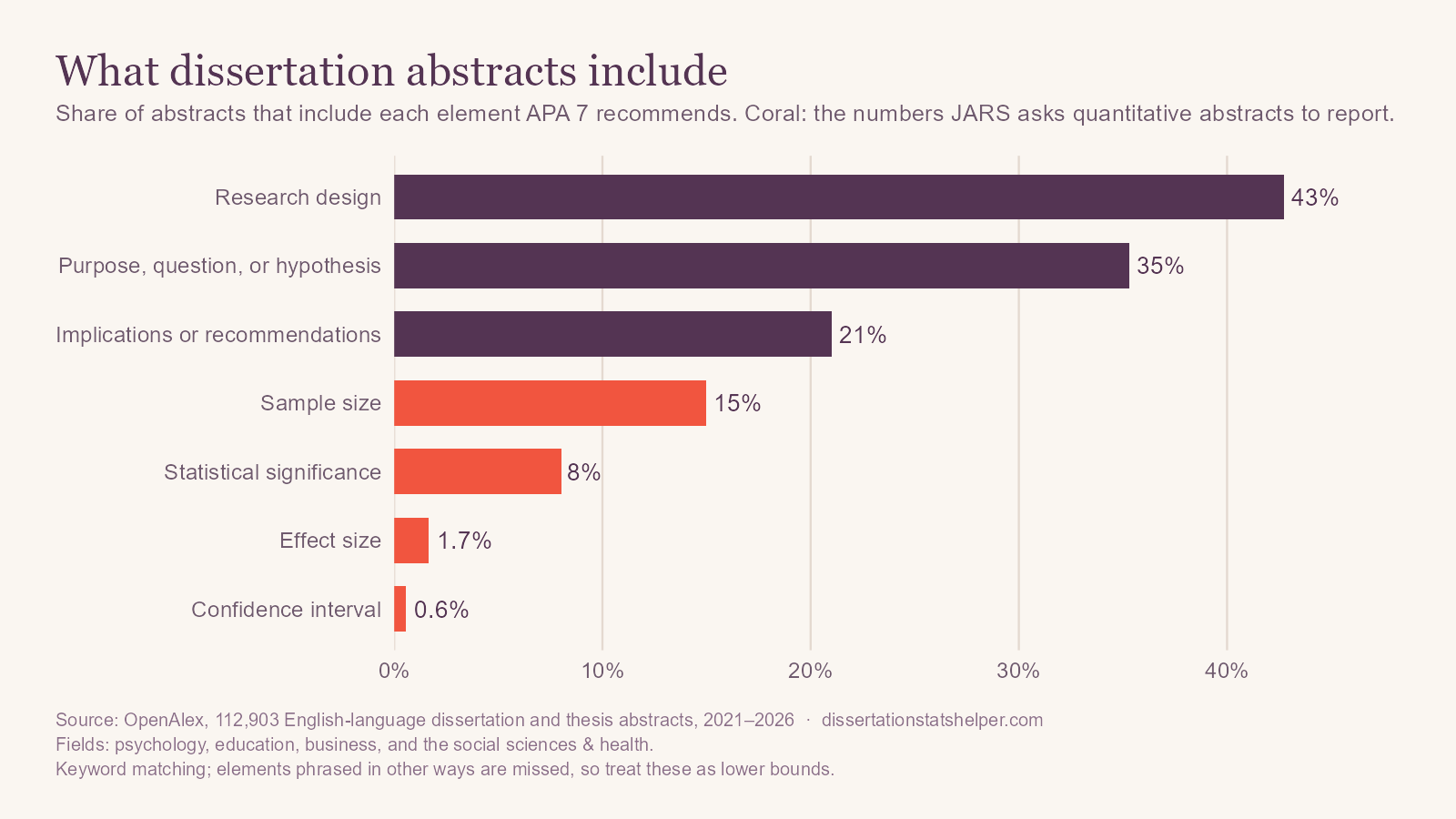
Abstracts describe what they studied and how, but rarely report the numbers. About 43% name a research design and 35% state a purpose, question, or hypothesis in a recognizable way. But only 15% give a sample size, 8% report statistical significance, 1.7% report an effect size, and 0.6% report a confidence interval. Fewer than 1% report both a sample size and an effect size.
That is not only because many studies are qualitative. Among the 23,093 abstracts that name a statistical method, 30% give a sample size, 24% report statistical significance, 5.5% report an effect size, and 2% report a confidence interval. Even where APA's quantitative standards clearly apply, about 19 in 20 abstracts leave out the effect size.
Psychology does best, as you might expect from the field that wrote the standards: 25% of psychology abstracts give a sample size and 3.4% an effect size, compared with about 13% and 0.9–1.8% in education, business, and the social sciences.
A template you can adapt
For a quantitative dissertation, five parts in about 250 words:
- Problem (1–2 sentences). What gap or problem does the study address, and why does it matter?
- Purpose (1 sentence). What did you test or examine? State hypotheses if you had them.
- Method (2–3 sentences). Design, who took part and how many, the key measures, and how data were collected.
- Results (2–3 sentences). The main findings, with the numbers: effect sizes with confidence intervals, or at least the direction, size, and significance.
- Conclusions (1–2 sentences). What the findings mean and for whom, and the main limitation if it changes the interpretation.
Here is a made-up example that follows the template (165 words):
First-generation college students leave science majors at higher rates than their peers, but few campus programs have been evaluated. This study tested whether a peer-mentoring program improved second-year persistence in science majors among first-generation students. Using a quasi-experimental design, I compared 412 first-generation students who joined the program in their first semester with 412 nonparticipants at the same public university, matched on high school GPA, first-semester credits, intended major, and Pell eligibility. Persistence was measured from registrar records one year after entry. Participants were more likely to remain in a science major in their second year (78% vs. 69%; risk difference = 9 percentage points, 95% CI [3, 15]). The difference was larger for students who attended at least six mentoring sessions. Because students chose to join, unmeasured motivation may explain part of the effect. The findings suggest that peer mentoring is a promising, low-cost support for first-generation students, and that universities adopting it should track participation and persistence to test it under stronger designs.
Keywords: first-generation students, peer mentoring, STEM persistence, propensity score matching, higher education
For a qualitative dissertation, keep the same shape but name the approach and analytic strategy (for example, interpretative phenomenological analysis), the participants and how many, the data (such as semi-structured interviews), and the main themes, rather than statistics.
Common mistakes
- Promising instead of reporting. “Results and implications are discussed” tells the reader nothing. State the findings.
- “Significant” with no size. Say how large the difference or relationship was, ideally with an effect size and interval.
- No sample size. It is one number, and readers use it to judge everything else.
- A long literature review. Keep background to a sentence or two; the abstract is about your study.
- Undefined abbreviations and jargon. Spell out anything a reader outside your subfield wouldn't know.
- Future tense in the final version. Proposals describe what you will do; the dissertation abstract reports what you did, in past tense.
- Ignoring your graduate school's limit. Check it before trimming to APA's 250 words or ProQuest's 350.
Checklist
- States the problem and the purpose or hypotheses
- Names the design and the sample, with its size
- Names the key measures or data sources
- Reports the main results with numbers (effect sizes, intervals, or significance)
- States conclusions and implications
- One paragraph, past tense, no undefined abbreviations
- Within your institution's word limit
- Three to five keywords covering topic, population, and method
Writing the chapter your abstract summarizes? See our guide to the results chapter, with APA formatting rules and example write-ups.
How we did this
We used the same OpenAlex data as our methods series: every English-language dissertation and thesis with an abstract longer than 60 words, published from 2021 through September 2026, in psychology, education, business, and the social sciences and health (112,903 abstracts). We searched each abstract for each element with keyword patterns, such as “N =” or a number followed by “participants” for sample size, and spot-checked the matches. Elements phrased in other ways are missed, so the shares are lower bounds. The data include master's theses and many non-US works, and some abstracts indexed as English are partly in other languages. The APA guidance summarized here comes from the APA Style Abstract and Keywords Guide, the Publication Manual (7th ed., sections 2.9–2.10), and JARS–Quant Table 1. The analysis code and result tables are on GitHub.