
- of method-naming psychology abstracts mention mediation
- 16%
- in organizational behavior and HRM
- 28%
- of mediation abstracts report a confidence interval
- 2%
A mediation question asks how or why one variable relates to another: does transformational leadership raise employee engagement through psychological safety? Does a mentoring program improve persistence by building self-efficacy? Many dissertations answer questions like these with Andrew Hayes's PROCESS, a free add-on for SPSS, SAS, and R. The simplest mediation model in PROCESS is Model 4.
In our analysis of recent dissertation and thesis abstracts, mediation appears in 16% of method-naming psychology abstracts and 28% of organizational behavior and HRM abstracts, yet only 2% of abstracts that name mediation report a confidence interval. This guide covers the model, how to run it, how to read the output, how to report it in APA 7, and the questions committees ask most.
The model in one picture
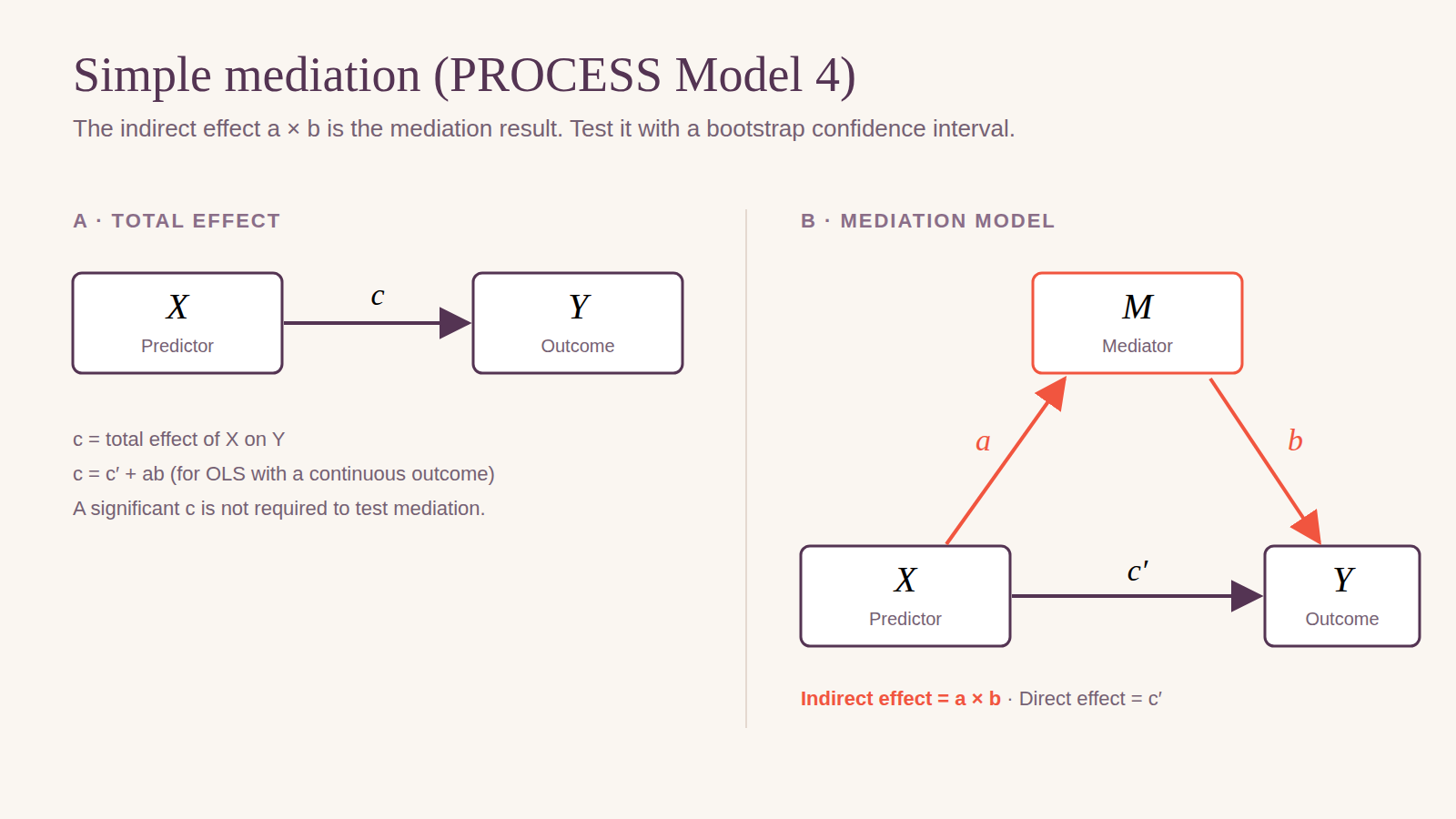
Model 4 estimates two regressions. The first predicts the mediator from the predictor, giving path a. The second predicts the outcome from both the predictor and the mediator, giving path b (mediator to outcome, holding the predictor constant) and the direct effect c′ (predictor to outcome, holding the mediator constant). The indirect effect is the product ab. With ordinary regression and a continuous outcome, the total effect splits exactly into the two parts: c = c′ + ab.
The indirect effect is the answer to your mediation question. Its size is in the outcome's units: an indirect effect of 0.14 means that a one-unit difference in the predictor is associated with a 0.14-unit difference in the outcome through the mediator.
Why PROCESS tests the indirect effect directly
Older dissertations often follow Baron and Kenny's (1986) causal steps: show that X predicts Y, X predicts M, and M predicts Y controlling for X, then compare the X coefficient with and without M. Current practice, and Hayes's book Introduction to Mediation, Moderation, and Conditional Process Analysis (3rd ed., 2022), tests the indirect effect itself instead, for three reasons:
- A significant total effect is not required. An indirect effect can exist when the total effect is small or not significant, for example when a positive indirect path and a negative direct path partly cancel.
- The steps never test ab. Two significant paths don't guarantee a reliably nonzero product, and the steps give no confidence interval for it.
- The product is not normally distributed. That is why the Sobel test, which assumes normality, is underpowered. PROCESS uses a percentile bootstrap confidence interval instead: it resamples your data thousands of times, computes ab each time, and takes the middle 95% of those estimates. If the interval excludes zero, you have evidence of an indirect effect.
Before you run it
- Theory and timing. Mediation is a causal claim. The model needs a reason the predictor would change the mediator and the mediator would change the outcome. Ideally the predictor is manipulated or measured first, the mediator next, and the outcome last.
- Scale scores. PROCESS works with observed variables, so compute each scale score first and report its reliability in your sample. Measurement error in the mediator weakens b and can bias c′.
- Covariates. Decide in advance which variables could confound the mediator–outcome relationship, and include them as covariates. Confounding of that path is the assumption committees probe most.
- Missing data. PROCESS drops any case missing a variable in the model. Report how many cases that removes, or handle missing data first (for example, with multiple imputation or with full-information estimation in SEM software).
- Sample size. Power depends on both paths. Fritz and MacKinnon's (2007) simulations suggest a percentile bootstrap needs roughly 560 cases for 80% power when both a and b are small, but fewer than 100 when both are medium. Use a Monte Carlo power analysis for your expected paths; our power analysis guide covers how to plan and justify it.
Running Model 4
Download PROCESS from processmacro.org. The examples below use version 4 and the leadership example: predictor lead, mediator safety, outcome engage, and two covariates.
SPSS. Install PROCESS as a custom dialog, or open process.sps, run it once to define the macro, and then run:
process y=engage /x=lead /m=safety /cov=tenure female
  /model=4 /total=1 /stand=1 /boot=5000 /seed=31216.
R. Run source("process.R") once, and then:
process(data = survey, y = "engage", x = "lead", m = "safety",
        cov = c("tenure", "female"), model = 4, total = 1,
        stand = 1, boot = 5000, seed = 31216)
total=1 adds the total effect model, stand=1 adds standardized effects, boot sets the number of bootstrap samples (5,000 is the default), and seed makes the bootstrap interval reproducible. Report the seed so your results can be reproduced. Option names occasionally change between versions, so check the documentation that comes with your copy.
Reading the output
PROCESS prints one block per regression and then a summary of the effects:
- Outcome variable: safety. The mediator model. The coefficient for
leadis path a. R² is the variance in the mediator explained. - Outcome variable: engage. The outcome model. The coefficient for
safetyis path b, and the coefficient forleadis the direct effect c′. - Total effect model. Printed with
total=1. The coefficient forleadis the total effect c. - Total, direct, and indirect effects of X on Y. The indirect effect row gives Effect (ab), BootSE, and BootLLCI and BootULCI, the bootstrap confidence limits. This row is your mediation result.
There is no p value for the indirect effect. The bootstrap interval is the test: if BootLLCI and BootULCI are both above zero or both below zero, the indirect effect is statistically different from zero. Because the interval comes from resampling, it can be asymmetric around the estimate, which is expected.
Reporting it in APA 7
Report every path with its standard error or confidence interval, the direct and total effects, and the indirect effect with its bootstrap interval, the number of bootstrap samples, and the type of interval. A path diagram with the coefficients, or a table of the two regression models, helps readers check the numbers. These made-up numbers are internally consistent (c = c′ + ab), so you can use them as a template:
We tested whether psychological safety mediated the association between transformational leadership and work engagement using PROCESS Model 4 (Hayes, 2022), controlling for tenure and gender. Confidence intervals for the indirect effect were percentile bootstrap intervals based on 5,000 resamples.
Transformational leadership was positively associated with psychological safety, a = 0.45, SE = 0.06, 95% CI [0.33, 0.57], p < .001, and psychological safety was positively associated with engagement, controlling for leadership, b = 0.31, SE = 0.05, 95% CI [0.21, 0.41], p < .001. The indirect effect of leadership on engagement through psychological safety was positive, ab = 0.14, 95% bootstrap CI [0.07, 0.22]; the completely standardized indirect effect was .12, 95% CI [.06, .18]. Leadership remained associated with engagement after accounting for psychological safety, direct effect c′ = 0.20, SE = 0.07, 95% CI [0.06, 0.34], p = .005. The total effect was c = 0.34, SE = 0.07, 95% CI [0.20, 0.48], p < .001.
Note what the write-up leaves out: it doesn't call the result “partial mediation,” and it doesn't say leadership causes engagement through safety. Our results chapter guide covers the general APA 7 formatting rules.
Questions committees ask
“Why didn't you follow Baron and Kenny's steps?” Because the steps don't test the indirect effect and require a significant total effect that mediation doesn't need. Cite Hayes (2022) and, if you like, Zhao, Lynch, and Chen (2010), who make the same case.
“The total effect isn't significant. How can there be mediation?” The total effect is the sum of the direct and indirect effects, and the two can have opposite signs. A reliable indirect effect is meaningful on its own. Report both and discuss what the pattern implies.
“Is this full or partial mediation?” Those labels depend on whether c′ happens to be significant, which depends on sample size. Hayes recommends against them. Report the size of the direct and indirect effects instead.
“Your data are cross-sectional. Can you claim mediation?” A cross-sectional model can show that the data are consistent with the proposed process, not prove it. Say so in your limitations, explain the theoretical ordering, and, if you can, note that the reverse model (swapping mediator and outcome) is not a test of direction either.
“What about variables you didn't measure?” An unmeasured variable that affects both the mediator and the outcome can create or hide an indirect effect, even in a randomized study where only the predictor was manipulated. Name the likely confounders, include what you measured as covariates, and acknowledge the rest.
“Why PROCESS rather than structural equation modeling?” For observed scale scores, PROCESS and SEM give essentially the same estimates. SEM is the better choice when you want latent variables to correct for measurement error, full-information handling of missing data, or a model PROCESS doesn't include.
Beyond Model 4
PROCESS numbers its models; Hayes's book and the PROCESS documentation include a diagram of each. The ones dissertations use most after Model 4:
- Several mediators at once. Model 4 accepts more than one mediator and estimates them in parallel, with a specific indirect effect for each. Model 6 puts mediators in a chain (serial mediation).
- Moderation. Model 1 tests whether a moderator changes the effect of the predictor on the outcome.
- Moderated mediation. Model 7 lets a moderator change path a, Model 14 path b, and Model 15 path b and the direct effect. The key result is the index of moderated mediation with its bootstrap interval, not separate tests at each moderator value.
Common mistakes
- Reporting only the paths. The indirect effect and its bootstrap interval are the result.
- Using the Sobel test as the main test.
- Stopping when the total effect isn't significant. Test the indirect effect anyway, as planned.
- “Full” and “partial” mediation as findings.
- Causal language from cross-sectional data without saying what the design can and can't show.
- No seed and no resample count, so the interval can't be reproduced.
- Silent listwise deletion. Report the analytic sample for each model.
- Pasting PROCESS output instead of an APA table or path diagram.
Checklist
- Mediation hypothesis stated with its theoretical rationale and variable ordering
- Scale reliability, covariates, and missing-data handling reported
- Sample-size justification for the indirect effect
- PROCESS version, model number, and software named
- Paths a and b, direct effect c′, and total effect c, each with SE or CI
- Indirect effect ab with its 95% percentile bootstrap CI, number of resamples, and seed
- A standardized indirect effect if your field expects one
- Path diagram or table of both regression models
- No “full” or “partial” mediation; causal limits in the discussion
How we did this
The method follows Hayes's Introduction to Mediation, Moderation, and Conditional Process Analysis (3rd ed., Guilford Press, 2022) and the PROCESS version 4 documentation. The sample-size figures come from Fritz and MacKinnon (2007), “Required sample size to detect the mediated effect,” Psychological Science, 18(3), 233–239. The share of abstracts mentioning mediation comes from our psychology and business methods overviews, and the reporting rate from the same 112,903 OpenAlex dissertation and thesis abstracts as our results chapter guide. The analysis code and result tables are on GitHub.