
- abstracts analyzed
- 5,876
- name a quantitative method
- 37%
- mention a power analysis
- 0
Clinical psychology is the largest subfield in our analysis of 21,308 psychology dissertation and thesis abstracts, and it has the most distinctive statistical profile. Clinical dissertations are built to explain who struggles and why, and the methods they name reflect that.
What is in this sample
The most common topics are child and adolescent emotional development, eating disorders, migration and trauma, resilience, family and disability support, mindfulness and compassion interventions, and child abuse. Of the 5,876 abstracts, 37% name a quantitative method and 27% describe qualitative work. Along with applied psychology, clinical is where reviews are most common: 7% are systematic reviews or meta-analyses, compared with 4% across psychology.
The methods clinical dissertations name most
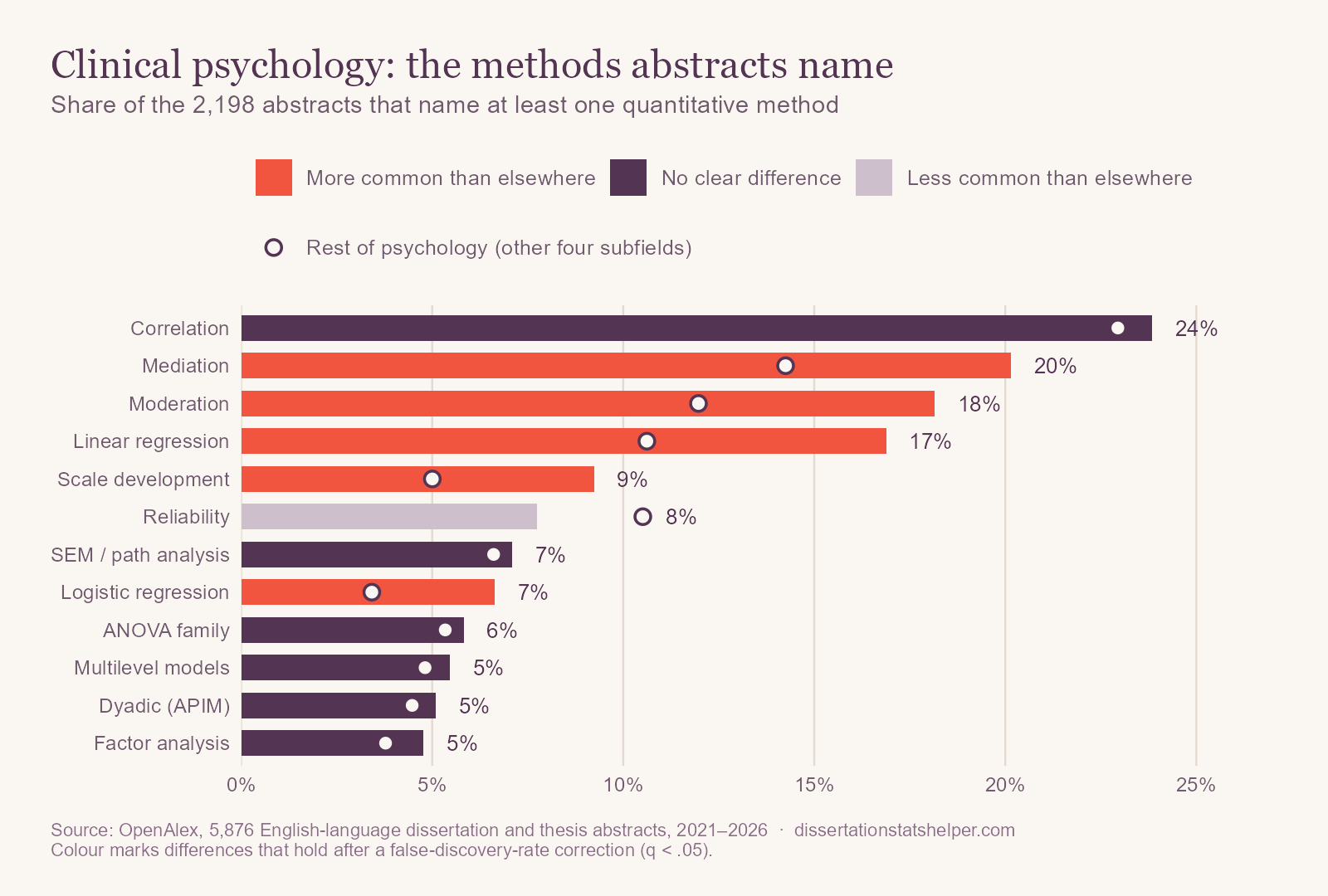
Six methods are clearly more common in clinical dissertations than in the other four subfields combined:
- Mediation (20% vs. 14%): testing the mechanism through which a risk factor affects an outcome.
- Moderation (18% vs. 12%): testing for whom or under what conditions an effect holds.
- Linear regression (17% vs. 11%): predicting symptom severity from several factors at once.
- Scale development (9% vs. 5%): building or adapting measures for new populations.
- Growth models (3% vs. 2%): tracking symptoms or treatment response over time. Rare, but more common than elsewhere.
- Logistic regression (7% vs. 3%): predicting a diagnosis, relapse, or other yes/no outcome.
Two things are less common. Reliability is mentioned less often than elsewhere (8% vs. 11%), even though clinical measures are central to the work. And machine learning appears in only 2% of clinical abstracts, compared with 10% elsewhere. Psychometric network analysis, widely discussed in the clinical literature, shows up in only 1.2%.
What changed since 2021
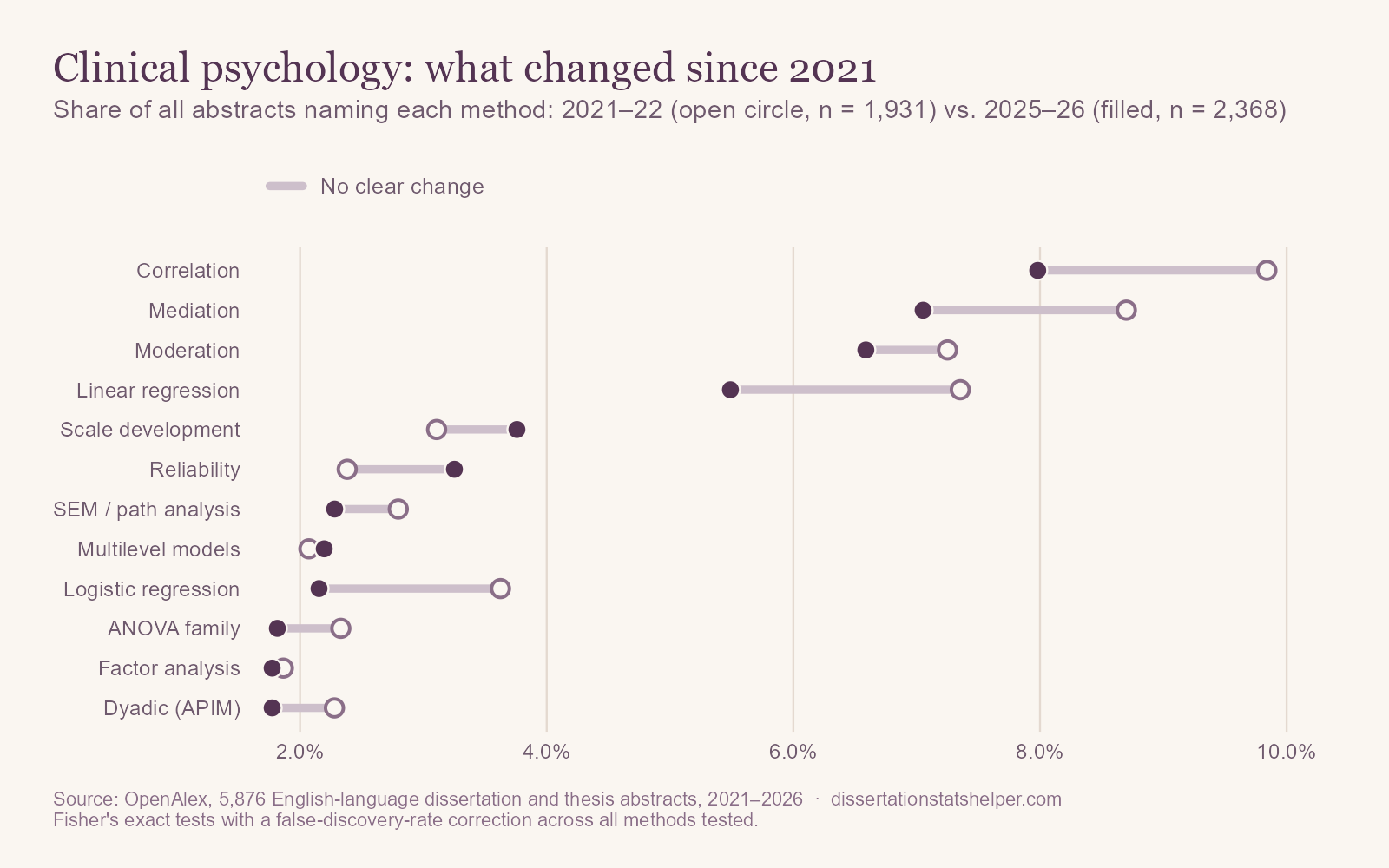
No single method changed enough to pass our correction for multiple tests. The largest raw moves were declines in logistic regression (3.6% to 2.2% of abstracts) and linear regression (7.4% to 5.5%), and a rise in latent profile analysis (9 abstracts to 27).
The clearer change is broader: fewer recent clinical abstracts name any quantitative method (42% in 2021–22 vs. 35% in 2025–26, p < .001). That shift pulls most individual method shares down with it.
What clinical abstracts leave out
Not one of the 5,876 abstracts mentions a power analysis, and only 7 mention how missing data were handled. Clinical samples are often small and hard to recruit, and moderation and mediation need more participants than simple associations. These are the questions committees ask, even when abstracts never answer them.
If you're planning a clinical psychology dissertation or thesis
- Be clear about what mediation can show. With cross-sectional data, an indirect effect is consistent with a mechanism but can't establish that X came before M, or M before Y. Say so, and use longitudinal or experimental designs where you can.
- Power your interactions. Moderation effects are usually small, and detecting them takes far larger samples than main effects. Plan the probing too: simple slopes or Johnson–Neyman regions.
- Treat binary outcomes carefully. For logistic regression, check you have enough events per predictor, and report odds ratios with confidence intervals.
- Show your measures work in your sample. Report reliability (omega or alpha), and test measurement invariance before comparing groups on an adapted scale.
How we did this
We used OpenAlex, an open index of scholarly works, to collect every English-language dissertation and thesis with an abstract published from 2021 through September 2026 in this subfield, kept abstracts longer than 60 words, and searched each title and abstract for about 30 statistical methods. The data include master's theses, so “dissertations” in this post is short for both. Percentages describe how often abstracts mention a method, not how often it was used. Comparisons use Fisher's exact tests with a false-discovery-rate correction, so a difference is only called a difference when it survives testing every method at once. The overview post has the full method and its limitations. The analysis code and result tables are on GitHub.