
- abstracts analyzed
- 1,998
- describe qualitative work
- 37%
- of method-naming abstracts use mediation
- 22%
Communication studies how messages are made, spread, and received. In our analysis of 50,799 social science and health dissertation and thesis abstracts, it is the most qualitative field, with a distinctive quantitative side built on media effects and digital data.
What is in this sample
The most common topics are international students and expatriates, social media and politics, media studies, public relations and crisis communication, knowledge sharing, and radio, podcasts, and digital media. Of the 1,998 abstracts, 37% describe qualitative work, 16% a survey, 12% a case study, and 7% content analysis. Only 19% name a quantitative method.
The methods these dissertations name most
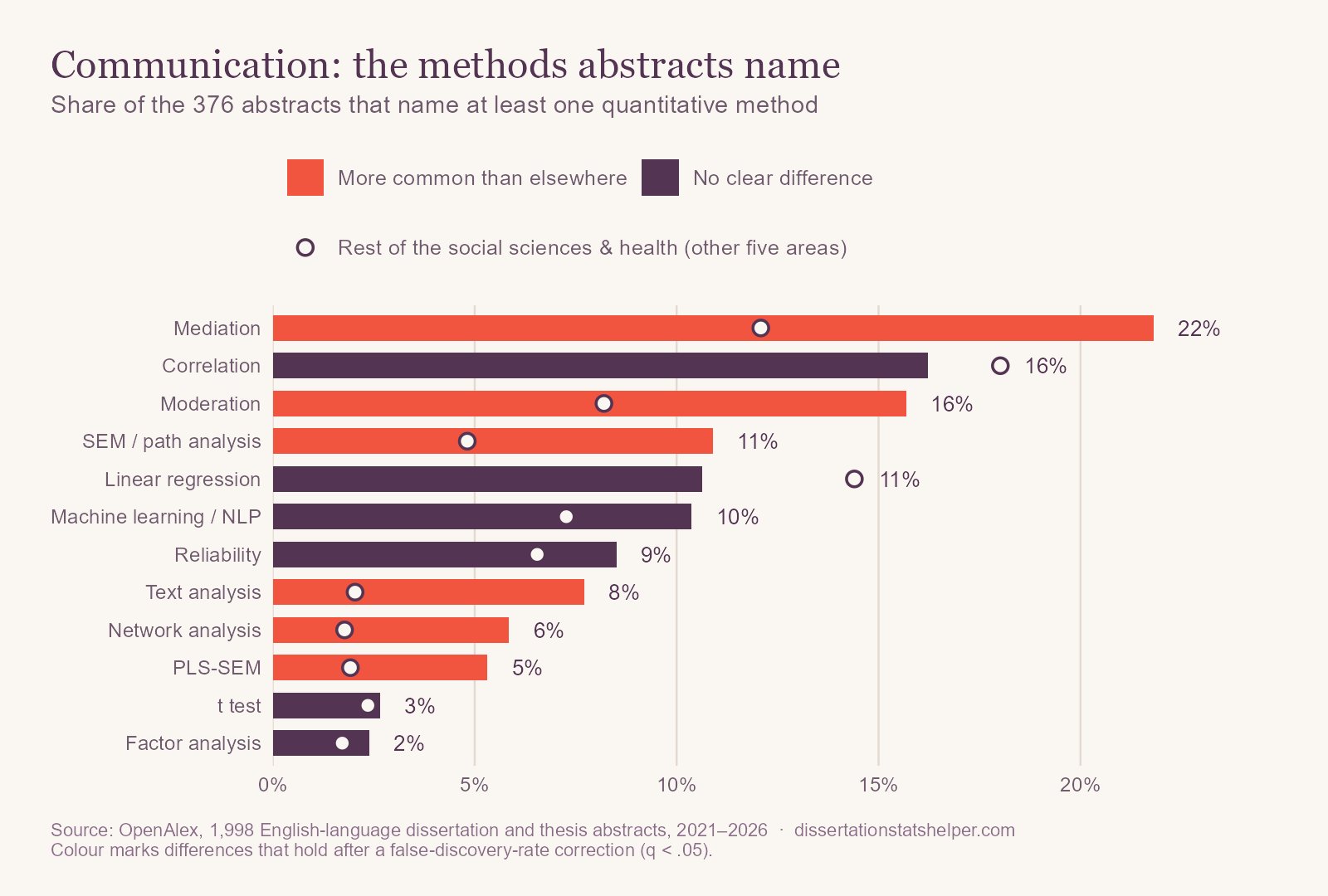
Mediation leads (22% vs. 12% in the other five fields), followed by correlation (16%) and moderation (16% vs. 8%). Structural equation models are more common too (11% vs. 5%). The digital side of the field shows up in text analysis (8% vs. 2%), such as sentiment analysis and topic models, and network analysis (6% vs. 2%) of how information spreads. Econometric and health methods are rare.
What changed since 2021
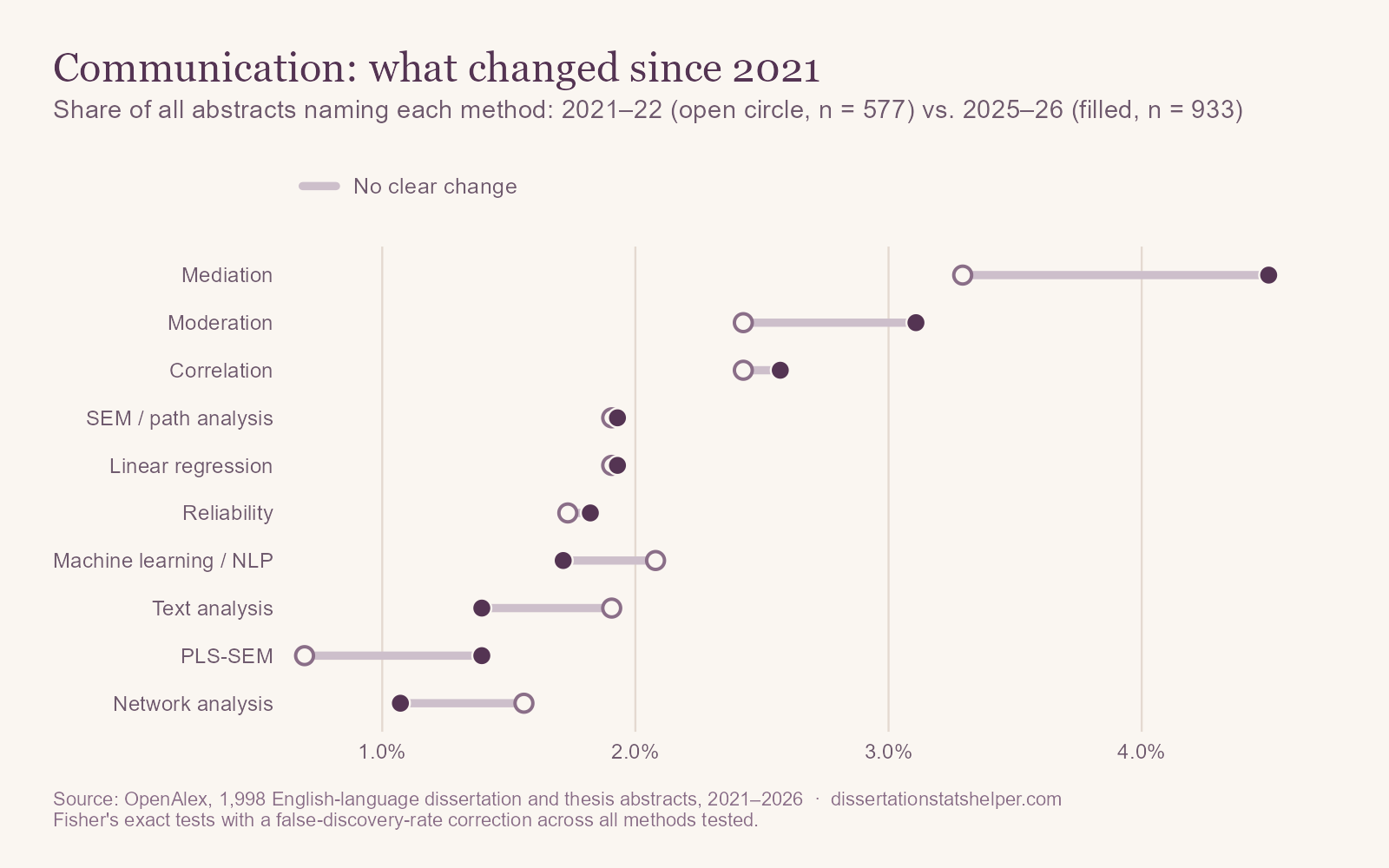
Nothing changed clearly. The share naming a quantitative method held at 19%, and no individual method's rise or fall survives our correction. With 376 method-naming abstracts, small changes are hard to detect.
What these abstracts leave out
None of the 1,998 abstracts mentions a power analysis, and two mention missing data. Media-effects experiments and surveys need both; content analyses need a reliability check between coders.
If you're planning a communication dissertation or thesis
- Report intercoder reliability. For content analysis, have a second coder code a sample and report Krippendorff's alpha or Cohen's kappa.
- Validate automated text measures. Check sentiment scores or topics against a hand-coded sample before trusting them.
- Consider an experiment for effects questions. Whether a message changes attitudes is best tested by showing different messages to different people.
- Treat survey mediation with care. Media use, attitudes, and behavior measured at one time can't establish order.
How we did this
We used OpenAlex, an open index of scholarly works, to collect every English-language dissertation and thesis with an abstract published from 2021 through September 2026 in this field, and searched each title and abstract for about 40 statistical methods, including econometric and health methods such as panel models, difference-in-differences, and survival analysis. The data include master's theses and many works from outside the United States, so “dissertations” here is short for all of them. Percentages describe how often abstracts mention a method, not how often it was used. Comparisons use Fisher's exact tests with a false-discovery-rate correction, and OpenAlex's coverage changes over time, so treat trends with some caution. The overview post has the full method and its limitations. The analysis code and result tables are on GitHub.