
- abstracts analyzed
- 3,778
- of method-naming abstracts use logistic regression
- 13%
- are systematic reviews
- 7%
Public health studies outcomes such as disease, death, and service use, and its methods follow. In our analysis of 50,799 social science and health dissertation and thesis abstracts, it is the field most focused on yes/no, count, and time-to-event outcomes.
What is in this sample
The most common topics are mosquito-borne diseases and malaria, obesity and physical activity, maternal mental health, reproductive health, palliative care, nutrition, opioid use disorder treatment, and medical education. Of the 3,778 abstracts, 31% name a quantitative method, 19% describe qualitative work, and 19% describe a survey. Public health has the highest shares of experiments or trials (5%) and systematic reviews (7%) in this series.
The methods these dissertations name most
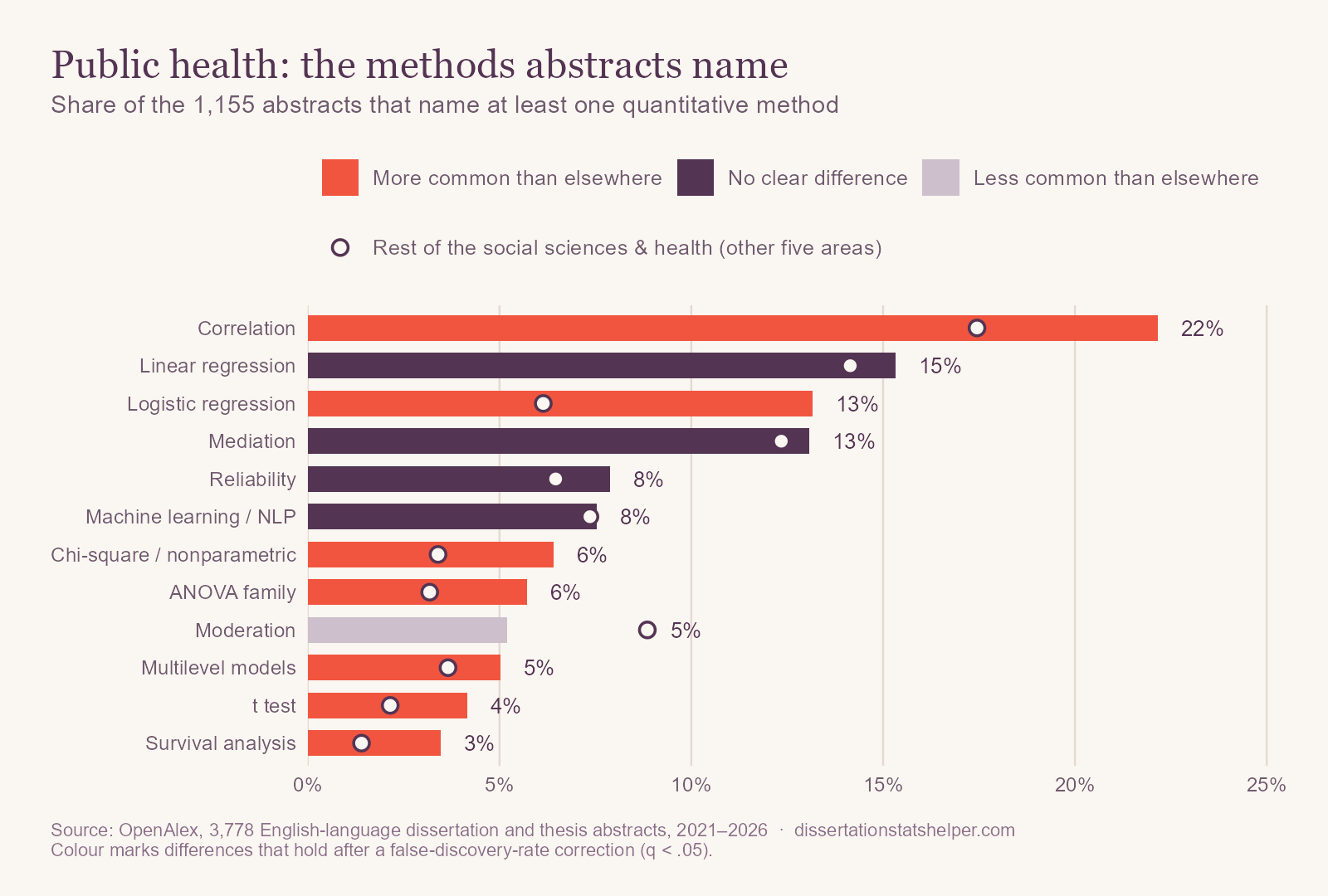
Compared with the other five fields, public health names logistic regression twice as often (13% vs. 6%), along with survival analysis (3.5% vs. 1.4%), count models (2.7% vs. 1.2%), chi-square (6% vs. 3%), multilevel models (5% vs. 4%), and correlation (22% vs. 17%). Econometric designs are rare: panel data (1% vs. 9%) and causal designs such as difference-in-differences (1% vs. 7%).
What changed since 2021
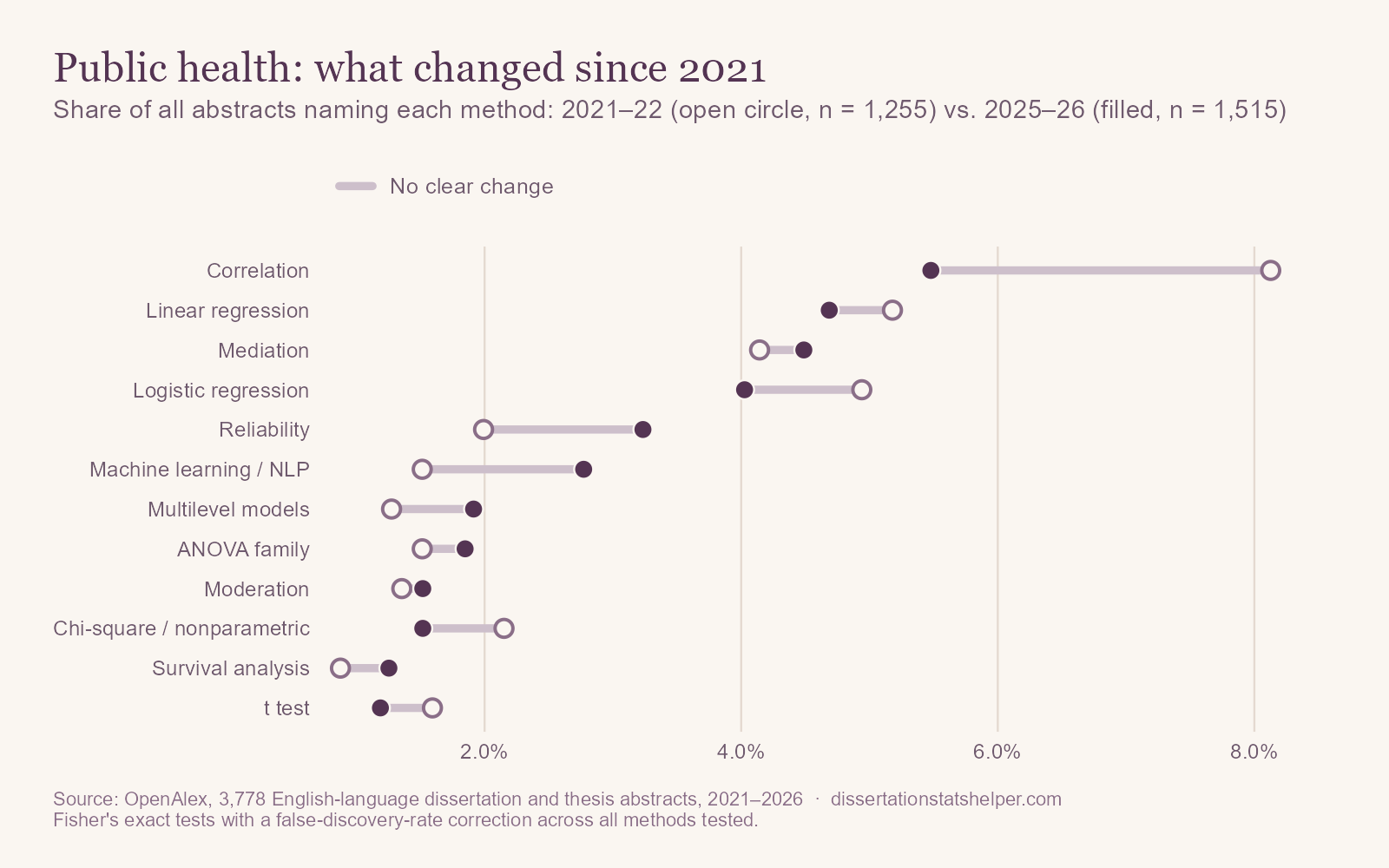
Nothing changed clearly. The share naming a quantitative method held at about 31–32%. Causal designs went from none to 11 abstracts, and correlation fell from 8.1% to 5.5% of abstracts, but neither survives our correction.
What these abstracts leave out
None of the 3,778 abstracts mentions a power analysis, and nine mention missing data. For trials and cohort studies, both belong in the protocol before data collection begins.
If you're planning a public health dissertation or thesis
- Report effects people can use. Alongside odds ratios, report predicted probabilities or risk differences; odds ratios overstate risk when outcomes are common.
- Use survival models for time-to-event outcomes. They handle people who haven't had the event by the end of follow-up.
- Choose count models deliberately. Check for overdispersion and excess zeros before settling on Poisson.
- Use survey design information. With BRFSS, NHANES, or DHS data, weights and strata are part of the analysis.
How we did this
We used OpenAlex, an open index of scholarly works, to collect every English-language dissertation and thesis with an abstract published from 2021 through September 2026 in this field, and searched each title and abstract for about 40 statistical methods, including econometric and health methods such as panel models, difference-in-differences, and survival analysis. The data include master's theses and many works from outside the United States, so “dissertations” here is short for all of them. Percentages describe how often abstracts mention a method, not how often it was used. Comparisons use Fisher's exact tests with a false-discovery-rate correction, and OpenAlex's coverage changes over time, so treat trends with some caution. The overview post has the full method and its limitations. The analysis code and result tables are on GitHub.