
- abstracts analyzed
- 9,301
- name a quantitative method
- 12%
- are case studies
- 12%
Political science and international relations is a field of case studies, comparison, and argument. In our analysis of 50,799 social science and health dissertation and thesis abstracts, it names a statistical method less often than any other field we have analyzed.
What is in this sample
The most common topics are gender and women's rights, Indonesian law and elections, populism, public administration in developing nations, electoral systems and participation, higher education governance, and water governance. Of the 9,301 abstracts, only 12% name a quantitative method, 17% describe qualitative work, 12% are case studies, and 3% use content analysis.
The methods these dissertations name most
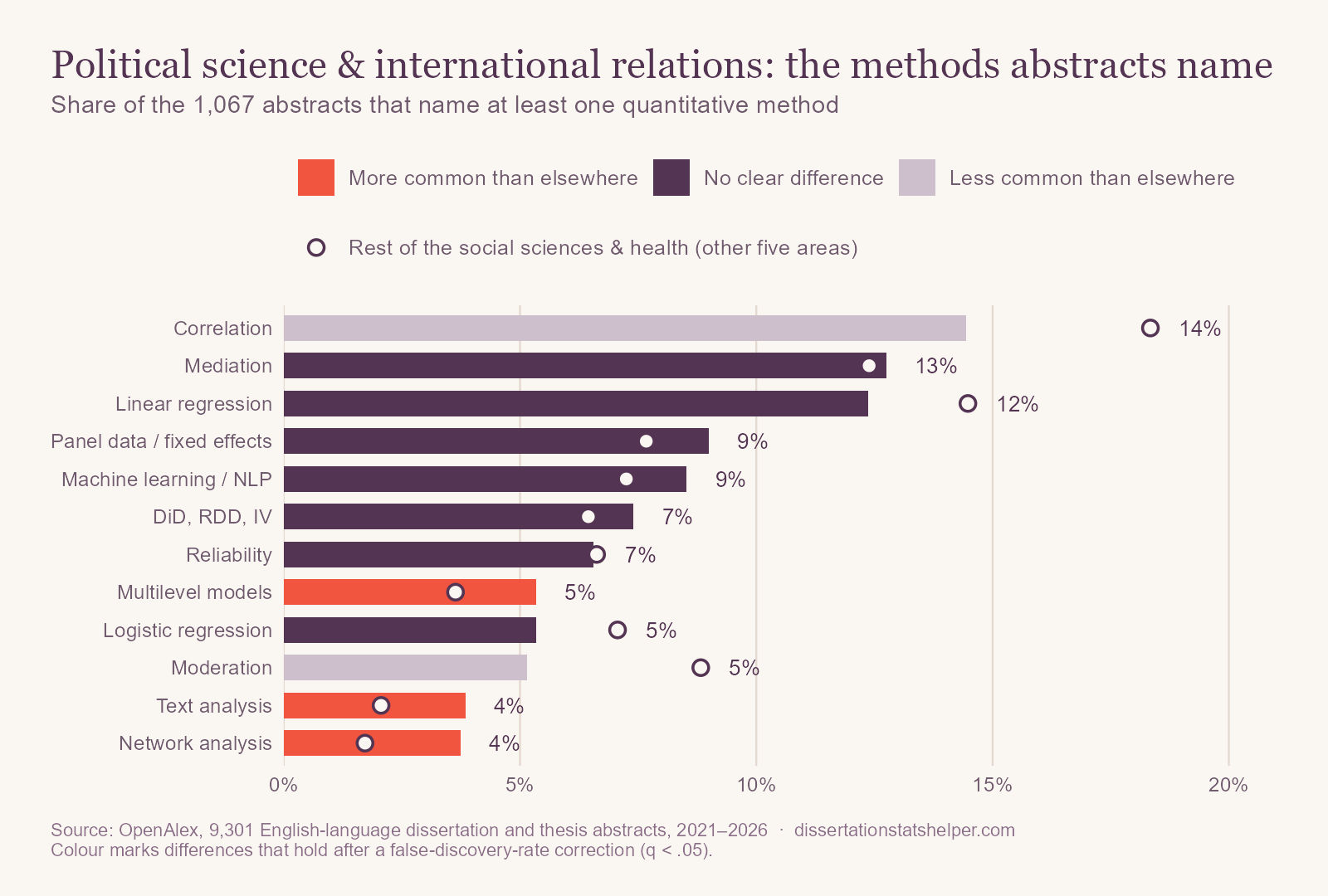
Correlation (14%), mediation (13%), and linear regression (12%) lead, followed by panel data models (9%) and machine learning (8%). Four methods are clearly more common here than in the other five fields: network analysis (4% vs. 2%), for alliances, trade, or legislative ties; text analysis (4% vs. 2%), for speeches, manifestos, and social media; multilevel models (5% vs. 4%), for voters within countries; and survival analysis (3% vs. 1.5%), for how long governments, conflicts, or ceasefires last. Correlation, moderation, SEM, and t tests are less common.
What changed since 2021
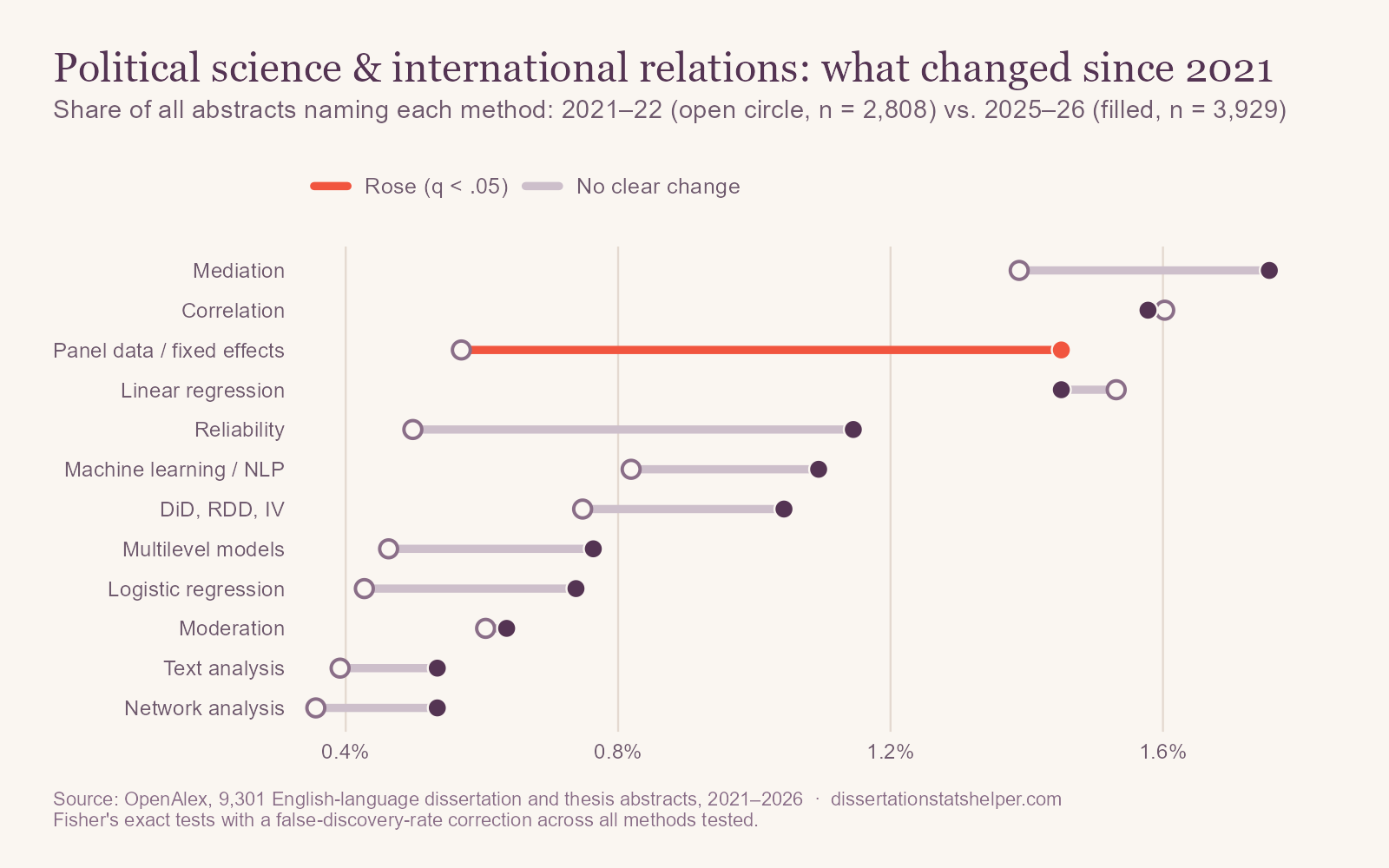
The share naming a quantitative method rose from 10% to 13%. Panel data models rose from 0.6% to 1.5% of abstracts, the only individual change that survives our correction.
What these abstracts leave out
None of the 9,301 abstracts mentions a power analysis, and five mention missing data. Country-year datasets have their own gaps: missing years, missing countries, and indicators that are least available where they matter most.
If you're planning a political science dissertation or thesis
- Treat country-years as panels. Use country and year fixed effects where appropriate, and cluster standard errors by country.
- Use duration models for “how long” questions. Survival analysis handles regimes, conflicts, and policies that haven't ended yet.
- Validate text measures. If you scale manifestos or classify tweets, check the automated measure against a hand-coded sample.
- Be explicit about case selection. In small-N designs, how you chose your cases shapes what you can conclude.
How we did this
We used OpenAlex, an open index of scholarly works, to collect every English-language dissertation and thesis with an abstract published from 2021 through September 2026 in this field, and searched each title and abstract for about 40 statistical methods, including econometric and health methods such as panel models, difference-in-differences, and survival analysis. The data include master's theses and many works from outside the United States, so “dissertations” here is short for all of them. Percentages describe how often abstracts mention a method, not how often it was used. Comparisons use Fisher's exact tests with a false-discovery-rate correction, and OpenAlex's coverage changes over time, so treat trends with some caution. The overview post has the full method and its limitations. The analysis code and result tables are on GitHub.