
- abstracts analyzed
- 2,699
- of method-naming abstracts use mediation
- 14%
- use causal designs such as DiD
- 7%
Leadership, teachers, and policy is the home of many EdD dissertations. In our analysis of 18,617 education dissertation and thesis abstracts, it has the most explanatory and policy-oriented toolkit in education.
What is in this sample
The most common topics are teacher education and leadership, school leadership and teacher performance, education systems and policy, discipline and inequality, and school choice. Of the 2,699 abstracts, 39% describe qualitative work, 20% describe a survey, 15% are case studies, and 8% use mixed methods. Only 17% name a quantitative method, the lowest share of any area. Eleven percent are tagged as US institutions.
The methods these dissertations name most
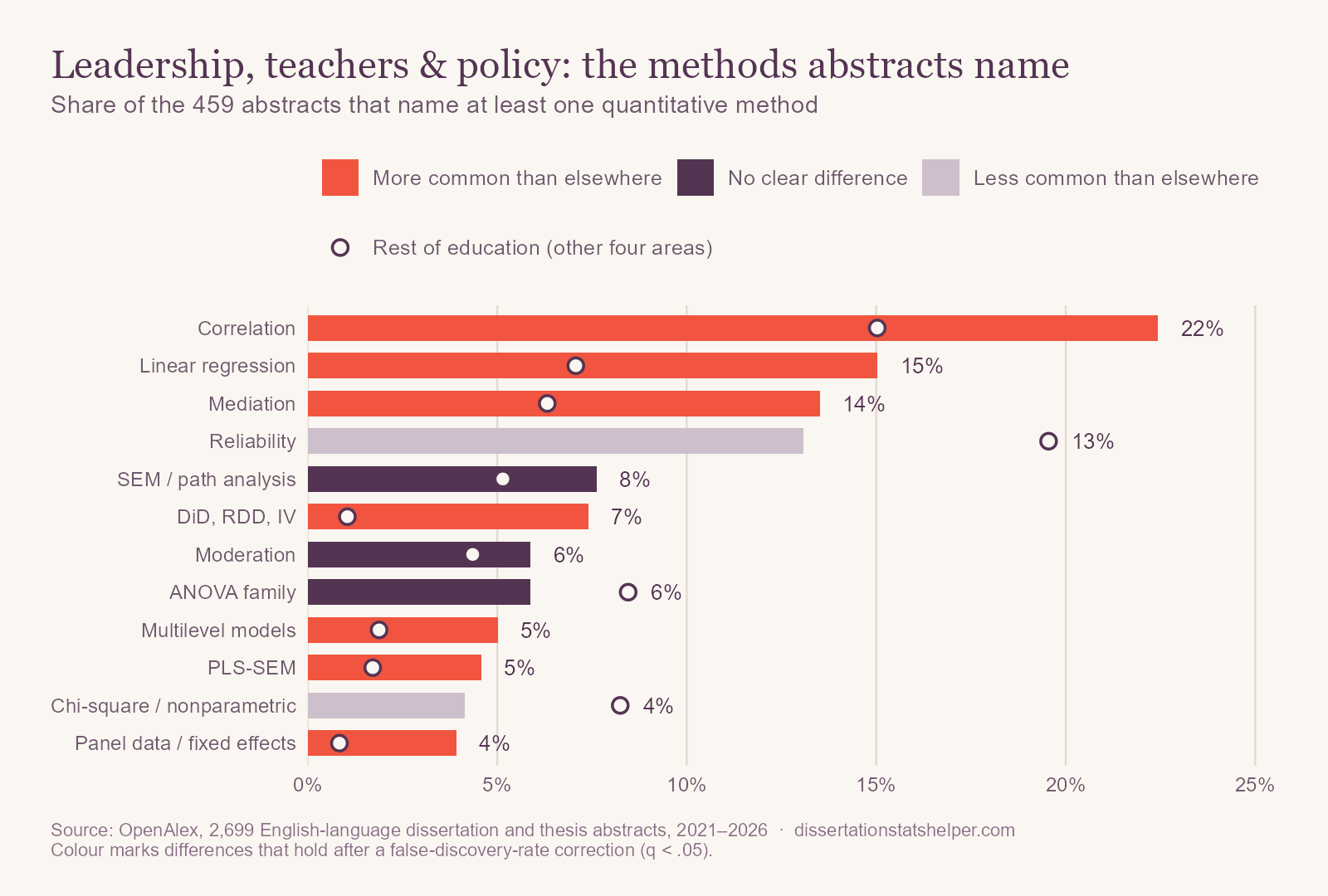
Several methods are clearly more common here than in the other four areas:
- Mediation (14% vs. 6%), often testing how leadership affects student outcomes through teachers or school climate.
- Linear regression (15% vs. 7%) and correlation (22% vs. 15%).
- Causal designs such as difference-in-differences and regression discontinuity (7% vs. 1%), plus panel data models (4% vs. 1%). These are the policy-evaluation tools, usually applied to state or district data.
- Multilevel models (5% vs. 2%), for teachers or students nested in schools.
t tests are rare (4%, vs. 28% elsewhere in education).
A note on change over time
Structural equation models rose from 1 abstract to 32, PLS-SEM from 0 to 17, and mediation from 11 to 37. OpenAlex added many repositories from outside the United States during this period, so shifts in education reflect who is in the index as much as how methods are changing. We don't chart them for that reason.
What these abstracts leave out
None of the 2,699 abstracts mentions a power analysis or missing data. Survey studies of teachers and principals often have modest response rates, and school-level analyses have far fewer units than it seems: 400 teachers in 12 schools is closer to 12 than to 400 for school-level questions.
If you're planning a leadership or policy dissertation or thesis
- Count the right units. If your question is about schools or leaders, your effective sample size is the number of schools, not respondents. Plan power at that level.
- Handle nesting. Teachers in the same school share a principal and climate. Use a multilevel model or cluster-robust standard errors.
- Use policy designs when you can. If a policy started at a known time in some districts, difference-in-differences compares change there with change elsewhere, a much stronger claim than a before–after comparison.
- Treat survey mediation with care. Leadership → climate → outcomes, measured in one survey, is consistent with a mechanism but cannot prove one.
How we did this
We used OpenAlex, an open index of scholarly works, to collect every English-language dissertation and thesis in education with an abstract published from 2021 through September 2026, grouped them by OpenAlex research topic, and searched each title and abstract for about 40 statistical methods. The data include master's theses, probably some undergraduate theses, and many works from outside the United States, so “dissertations” here is short for all of them. Percentages describe how often abstracts mention a method, not how often it was used. Comparisons use Fisher's exact tests with a false-discovery-rate correction. The overview post has the full method and its limitations. The analysis code and result tables are on GitHub.