
- abstracts analyzed
- 4,624
- of method-naming abstracts use t tests
- 31%
- use linear regression
- 4%
Teaching, learning, and curriculum is the largest area in our analysis of 18,617 education dissertation and thesis abstracts, and it has the most distinctive toolkit: test students before and after a new approach, check the instrument's reliability, and compare the means.
What is in this sample
The most common topics are teaching methods and learning outcomes, curriculum, STEM education, critical thinking, mathematics and science teaching, assessment and feedback, and writing. Of the 4,624 abstracts, 22% name a quantitative method, 22% describe qualitative work, and 12% describe a survey. Only 3.5% are tagged as US institutions, so this area mostly reflects classroom research from outside the United States.
The methods these dissertations name most
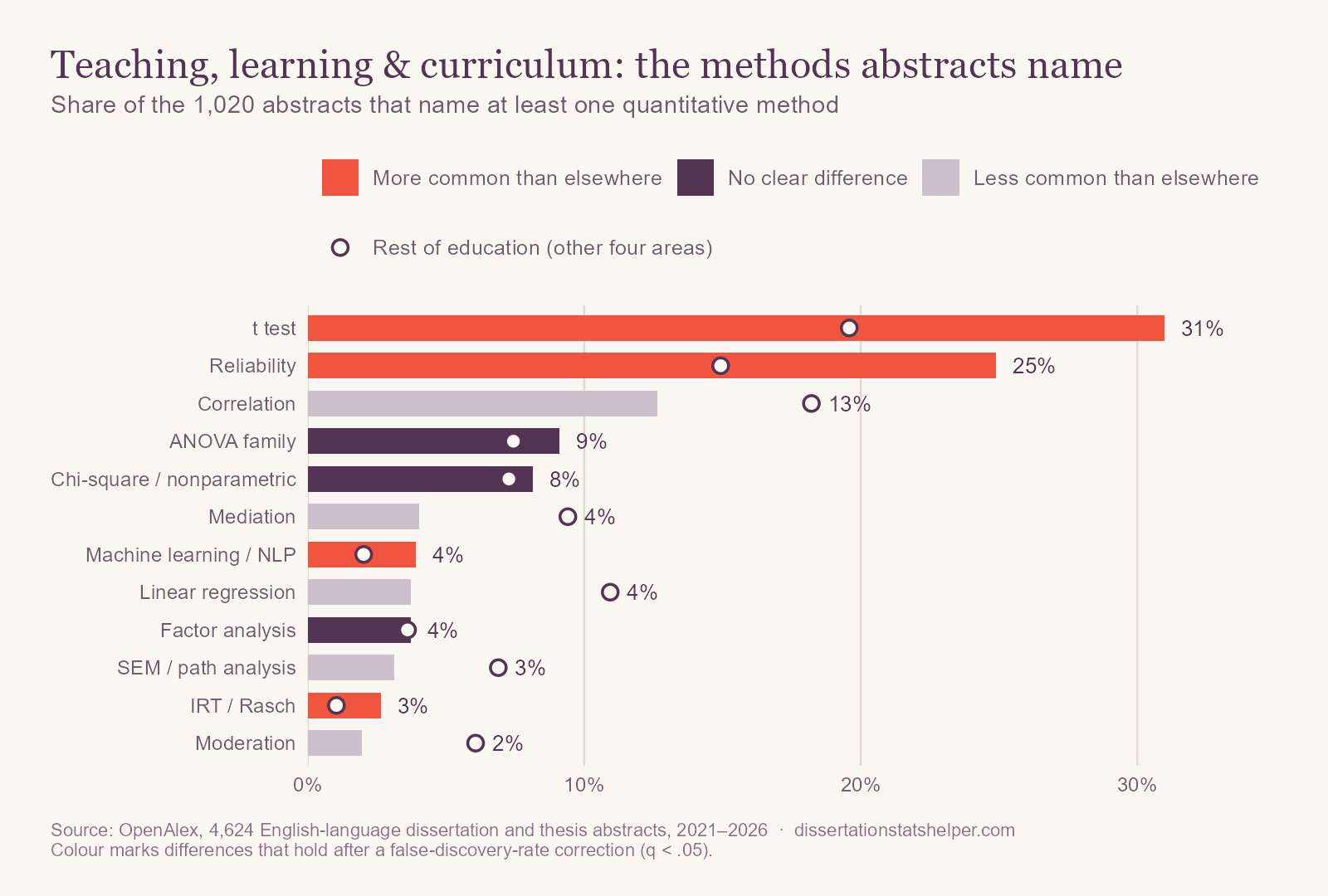
Four methods are clearly more common here than in the other four areas: t tests (31% vs. 20%), reliability (25% vs. 15%), item response theory and Rasch models (2.6% vs. 1.0%), and machine learning (3.9% vs. 2.0%, often automated scoring or learning analytics).
Explanatory models are rare. Linear regression appears in 4% of method-naming abstracts (vs. 11% elsewhere), mediation in 4% (vs. 9%), moderation in 2% (vs. 6%), and growth models are almost absent (0.1% vs. 1.2%). Logistic regression and causal designs such as difference-in-differences are almost absent (under 0.5%).
A note on change over time
t tests rose from 2.6% to 8.6% of abstracts in this area, and reliability from 3.1% to 8.1%. OpenAlex added many repositories from outside the United States during this period, so shifts in education reflect who is in the index as much as how methods are changing. We don't chart them for that reason.
What these abstracts leave out
None of the 4,624 abstracts mentions a power analysis, and one mentions missing data. For a pretest–posttest study with one or two classes, power is usually the weakest point, and a committee will ask about it.
If you're planning a teaching and learning dissertation or thesis
- Use the pretest, don't just compare it. With a comparison group, analysis of covariance on the posttest (adjusting for the pretest) is more powerful than separate t tests, and it answers the question you care about.
- Report effect sizes with intervals. Cohen's d (or Hedges' g for small groups) with a confidence interval tells readers how much students gained, not just whether the gain was significant.
- Account for intact classes. When whole classes receive the intervention, students within a class are not independent. With few classes, say so as a limitation; with more, use a multilevel model.
- Validate your test beyond alpha. For achievement tests, item analysis or a Rasch model shows which items work and for which students.
How we did this
We used OpenAlex, an open index of scholarly works, to collect every English-language dissertation and thesis in education with an abstract published from 2021 through September 2026, grouped them by OpenAlex research topic, and searched each title and abstract for about 40 statistical methods. The data include master's theses, probably some undergraduate theses, and many works from outside the United States, so “dissertations” here is short for all of them. Percentages describe how often abstracts mention a method, not how often it was used. Comparisons use Fisher's exact tests with a false-discovery-rate correction. The overview post has the full method and its limitations. The analysis code and result tables are on GitHub.