
- abstracts analyzed
- 5,124
- of method-naming abstracts use panel data
- 15%
- are case studies
- 17%
Strategy and management asks why some firms outperform others, and its dissertations often answer with firm-level data over time. In our analysis of 22,179 business dissertation and thesis abstracts, it sits between the survey-based and econometric sides of business.
What is in this sample
The most common topics are corporate social responsibility reporting, sustainable and resilient supply chains, international business and foreign direct investment, corporate governance, digital platforms, and innovation and knowledge management. Of the 5,124 abstracts, 24% name a quantitative method, 26% describe qualitative work, and 17% are case studies.
The methods these dissertations name most
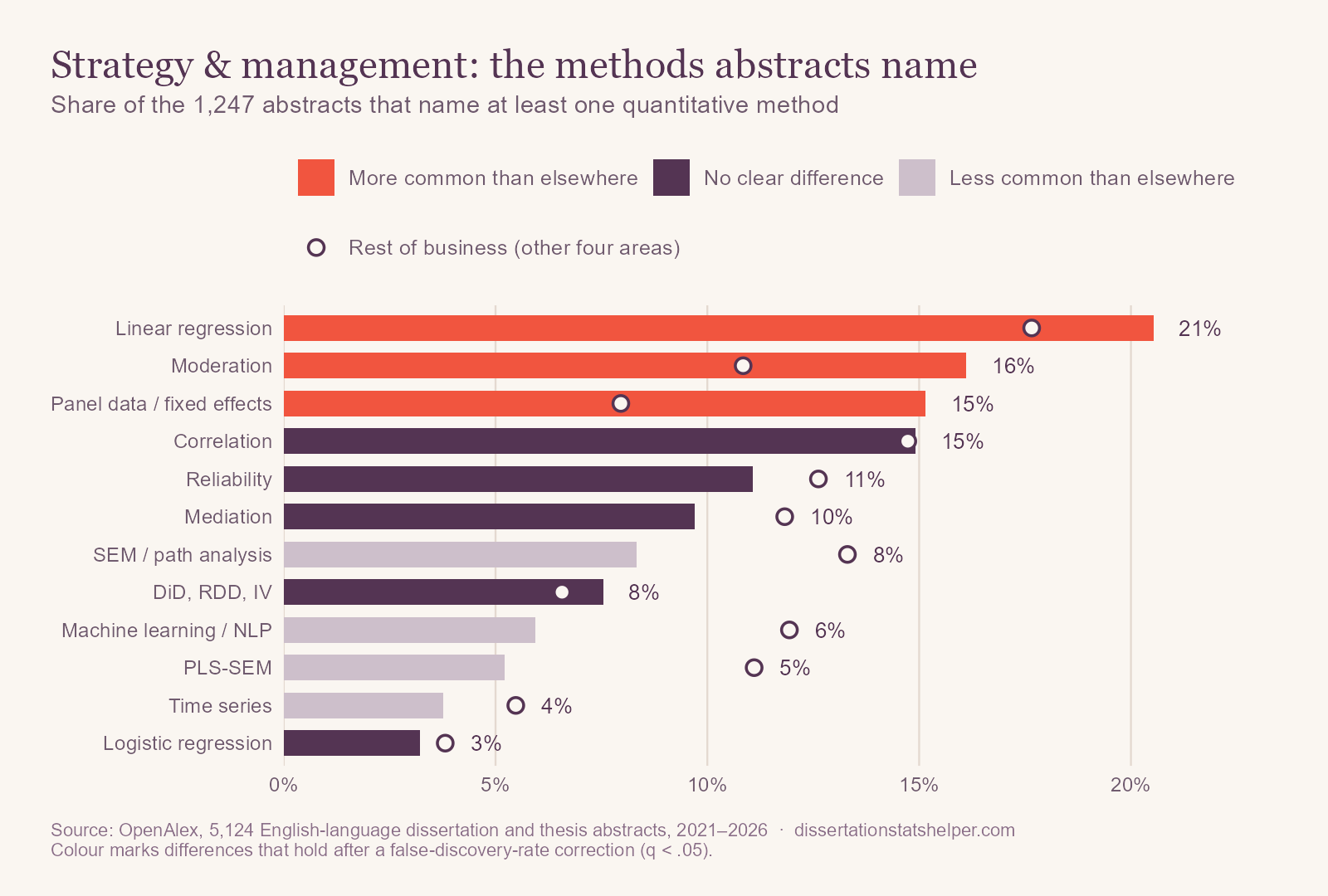
Linear regression leads (21%), followed by moderation (16%) and panel data models (15%). Compared with the other four areas, strategy names panel data models (15% vs. 8%), moderation (16% vs. 11%), and linear regression (21% vs. 18%) more often, the typical design being firm-year data with an interaction between, say, governance and environmental uncertainty. Network analysis (2% vs. 1%) and data envelopment analysis (1.6% vs. 0.4%) are small but distinctive. Survey-model methods are less common: SEM (8% vs. 13%), PLS-SEM (5% vs. 11%), and machine learning (6% vs. 12%).
What changed since 2021
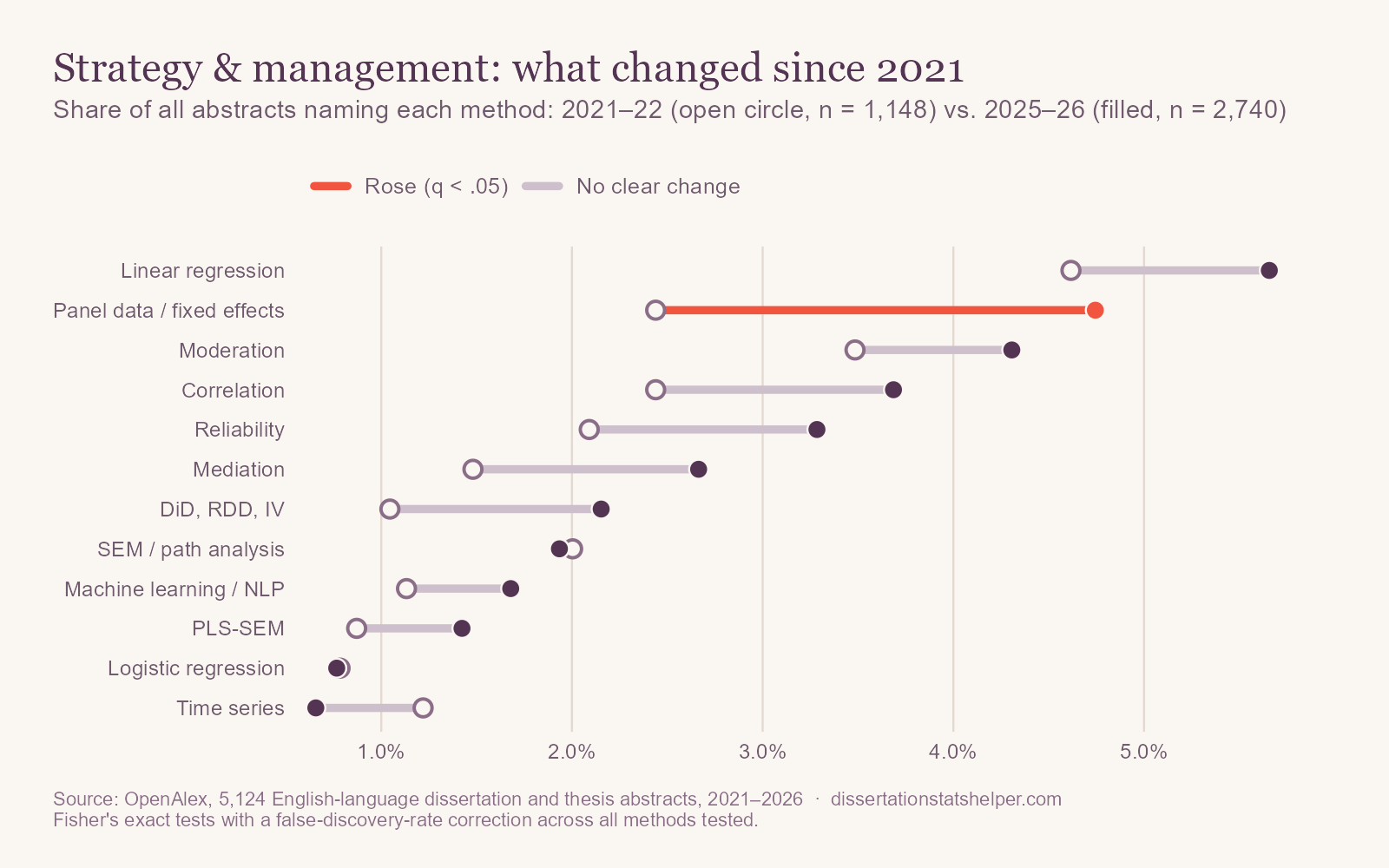
Panel data models rose from 2.4% to 4.7% of all abstracts, the only change that survives our correction for testing many methods. Causal designs (1.0% to 2.2%) and text analysis (1 abstract to 19) also rose, but not by enough to rule out chance.
What these abstracts leave out
None of the 5,124 abstracts mentions a power analysis, and one mentions missing data. Firm-level datasets often lose firms to mergers, delistings, or missing disclosures, and who drops out is rarely random.
If you're planning a strategy or management dissertation or thesis
- Choose fixed or random effects deliberately. Firm fixed effects remove stable differences between firms; report a Hausman or similar test and cluster standard errors by firm.
- Take endogeneity seriously. Firms choose their strategies. Lagged predictors are not a solution on their own; consider instruments or a difference-in-differences design where one exists.
- Probe your interactions. Report where along the moderator the effect is significant, not just the interaction coefficient.
- Document your sample. Report how many firms and years you started with and why each was dropped.
How we did this
We used OpenAlex, an open index of scholarly works, to collect every English-language dissertation and thesis with an abstract published from 2021 through September 2026 in this area, and searched each title and abstract for about 40 statistical methods, including econometric methods such as panel models and difference-in-differences. The data include master's theses and many works from outside the United States, so “dissertations” here is short for all of them. Percentages describe how often abstracts mention a method, not how often it was used. Comparisons use Fisher's exact tests with a false-discovery-rate correction, and OpenAlex's coverage changes over time, so treat trends with some caution. The overview post has the full method and its limitations. The analysis code and result tables are on GitHub.